


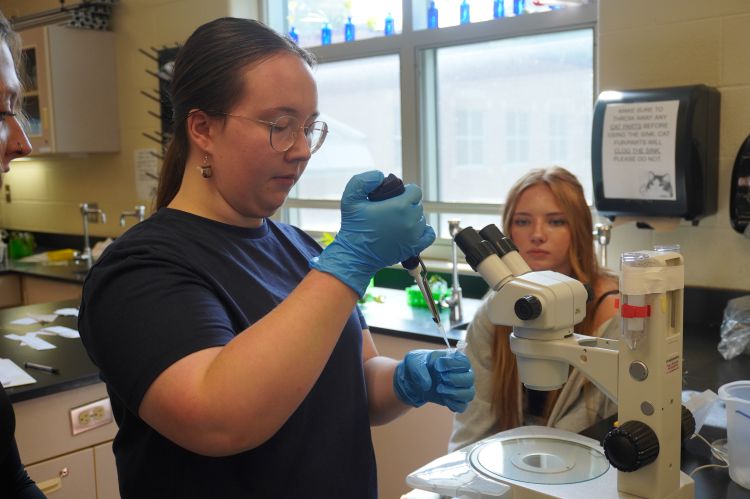
Lowell — It was egg prep day in Lowell High School’s Science Research class, which meant working with some really tiny worms to retrieve their even tinier eggs.
Using pipettes, microscopes, solutions and petri dishes, students carefully extracted eggs from microscopic roundworms called C. elegans. After that, they plated the eggs on different types of bacteria to see if they would hatch and grow into healthy worms.
The long-term goal: contribute to metabolic research with the hopes of leading to medical advancements. Modeled like a satellite lab for Dr. Nick Burton’s Nutritional Programming and Metabolic Research Department at Van Andel Institute, the students could potentially contribute their findings to ongoing research on insulin resistance, Type 2 diabetes, Parkinson’s disease and other metabolic disorders.
“We are trying to get the worms to produce insulin and grow to full size,” said senior Cody Foss.
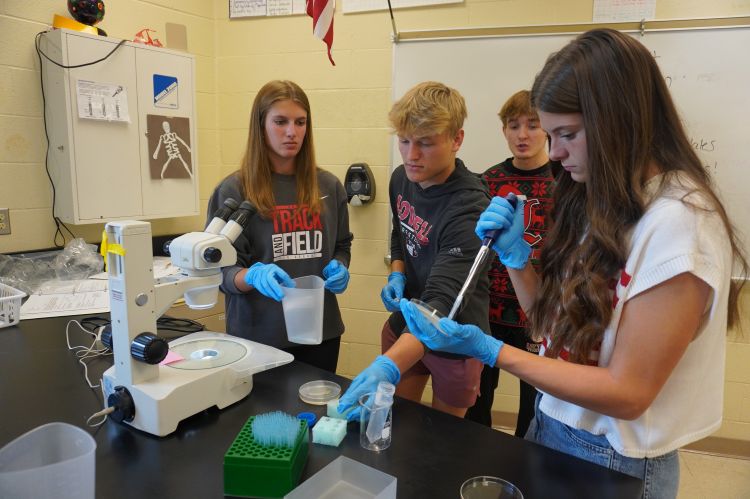
The tiny roundworms have a mutation in their insulin-signaling gene, and due to the mutation, they are small and sickly. Students are working to discover bacteria that, when exposed, allow the eggs to grow into healthy adult worms. The research could eventually benefit people with diabetes and other insulin-resistant diseases.
“The whole research is really behind if we can find a bacteria that will help these worms and essentially make them healthier,” teacher Erin Lewis said. “The Burton lab has found out that there are certain bacteria that can actually help these worms reverse this insulin resistance that they have, and they are wondering if there are more bacteria out there that can do that.
“We are going to see if one of their bacteria works.”
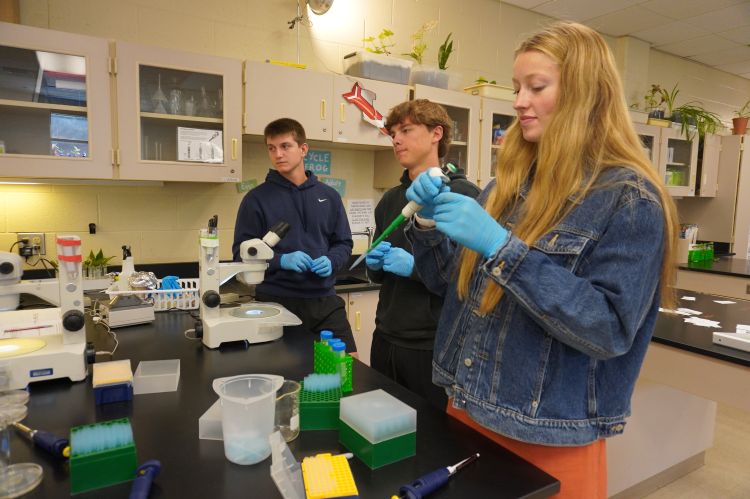
To prepare, students gathered soil samples from their yards, woods, lakes, compost and other areas. They diluted the bacteria from their samples and plated it on petri dishes. On egg prep day, they placed the eggs extracted from the worms onto the plates.
They started by looking at their worms through microscopes, determining which were mature enough for egg retrieval. They then continued a step-by-step process, bursting open the worms using a bleach solution, spinning them in a centrifuge and collecting the remaining eggs.
Senior Alison Smith discovered her egg harvest was plentiful, which meant she would be hatching a new generation of worms.
“It’s exciting that we get to say we contributed to this, because we are just high-schoolers. Most people don’t get the chance to try this and have this opportunity,” Alison said.
Senior Annika Hahn said she’s happy to have the opportunity to participate in high-level science research.
“The coolest thing has been doing the egg prep that we’re doing right now and seeing how we take the worms, dissolve them and that we are left with just the eggs,” Annika said.
An Evolving Partnership
Lowell High School has participated in a partnership with the Grand Rapids-based biomedical research institute for the past several years, and with Burton’s lab for the past four. Burton and other research scientists have helped run labs in former Lowell High School teacher Heather DeJonge’s class, with students involved in the work with C. elegans as one project option.
‘It’s exciting that we get to say we contributed to this, because we are just high-schoolers.’
— senior Alison Smith
This year, however, teacher Erin Lewis’ class is devoted entirely to the research for Burton’s lab, and she and students are running things on their own.
“We are like an offset to (Burton’s) lab,” Lewis said. “He is supplying us with everything. We are their guinea pigs.”
Burton said Lowell High School is helping him develop a framework for real–world, inquiry-based science that’s exciting for students.
“We are trying to build it into its own fixed curriculum that could be expanded to other high schools,” he said in an interview.
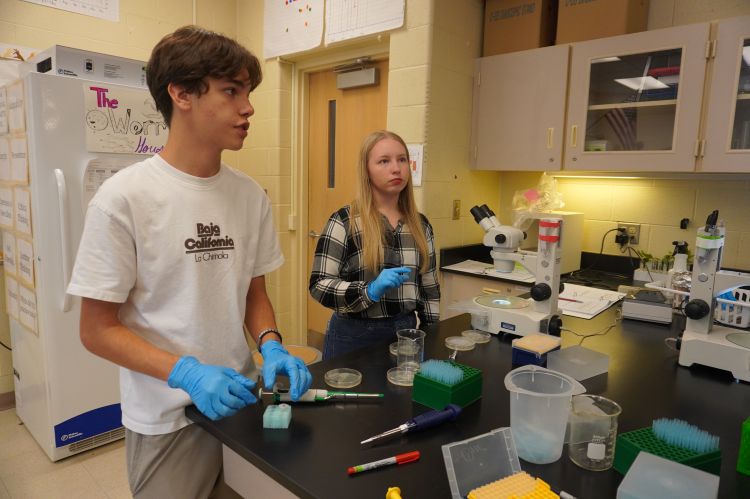
While it’s possible that students will discover a bacteria that leads to healthy worms, his goal is more for them to experience what it’s like to do the day-to-day work of a real scientist.
“It’s not really about me and what we need for the lab; it’s about providing an opportunity for high-school students,” he said. “I’m always most excited to see them get excited. We are really doing it to get them asking questions.”
Lewis said it’s an incredible chance for students to be researchers.
“The work they are doing is exactly what (VAI) is doing in their lab,” she said. “The opportunity that exists for high-schoolers to do this type of work is rare. It’s a great opportunity for a student who would be interested in this following high school. … This reminds me of a college lab or genetics class.”
The research class will also focus on how to read and present a journal article, scientific writing and presenting. They also plan to attend a Midwest C. elegans meeting at VAI in the spring.
Read more from Lowell:
• Chief meteorologist forecasted his future in first grade
• Social work goal born of real-life experience


