


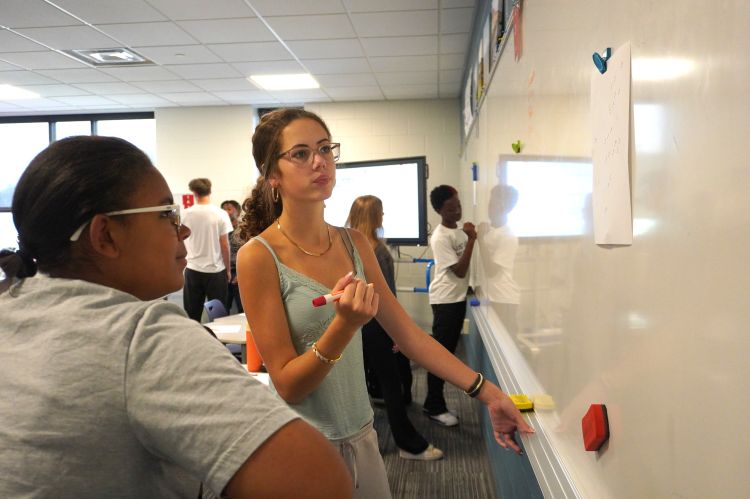
Wyoming — Landen Lee looked to his classmates Liliya Zuidema and Morgan Cramer while investigating an algebra problem.
“The pattern is going up by 400,” he said, as the trio compared numbers on a chart indicating the distance of a lap. One lap equals 400 meters, two laps equals 800 meters and so on, they noticed.
The team chatted about how to create an equation to represent that mathematical relationship. Landen then jotted down the group’s thoughts with a marker on a whiteboard.
‘How often do you stand in math class?’
— freshman Morgan Cramer
The Freshman Algebra class bustled with similar activity as students worked in groups of three on problems, figuring out patterns and writing equations on their own whiteboards.
“It’s one marker, three minds,” explained teacher Clare Bunton. Multiply that by several groups, and that equals a lot of collective brainpower.
The majority of the hour was spent on fast figuring, quick erasing, curious discussion and math discovery. Many groups went from being stumped as they began a problem, to ending with the correct answer.
“It’s a lot more teamwork and we all have to work together,” Landen said, comparing the class to traditional math instruction. “It’s better because we are all interacting.”
“You get to hear other people’s opinions, which can help you form your own,” added Liliya. “Seeing other people’s thinking can help.”
In Bunton’s class, you’ll rarely see students quietly sitting at desks and doing math individually, problem after problem, until the hour’s up. Instead, you’ll see groups of three students working together, learning from each other and finding correct answers using several strategies.
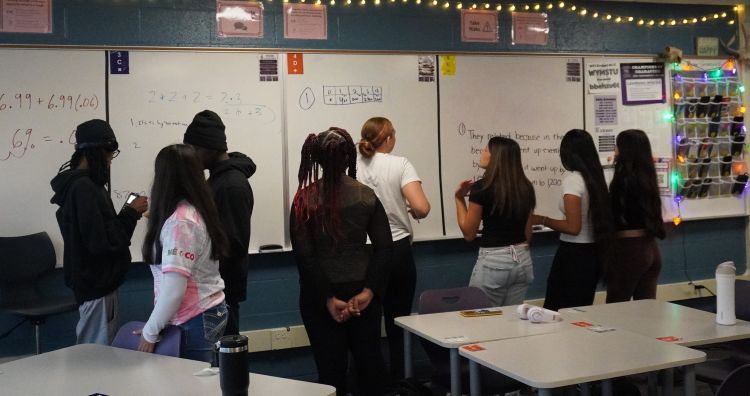
Students say it’s more engaging and makes more sense.
“It’s more memorable,” Morgan said. “How often do you stand in math class?”
Bunton loves the activity, the conversation and the energy in her class.
“It is crazy, It’s loud, it’s chaotic and some people get overwhelmed by it. But they are all talking about math and they are solving problems, which is not typical for an Algebra 1 classroom. It’s very different.”
Collaborating & Conversing
Wyoming High School teachers are using an approach to math instruction that integrates out-of-your seat, student-led group work with teacher-led topic introductions and full group discussion.
They are using strategies from Building Thinking Classrooms, which offers a set of 14 practices to use with math curriculums. The approach was developed by Dr. Peter Liljedahl, professor of mathematics education at Simon Fraser University in Canada, with the goal of getting more students “to think and to think longer,” according to the BTC website. The 14 practices range from whiteboard use to facing furniture for students to face each other, how to answer questions to prompt more thinking, to notetaking, assessments and grading.
‘It’s a lot more teamwork and we all have to work together. It’s better because we are all interacting.’
— freshman Landen Lee
Classes start with a task for students to work on at the whiteboard related to a math concept. It’s informal and open-ended in the beginning, allowing students to wrestle with the problem or idea. The teacher then explains the concept, sometimes teaching a related equation. That’s followed by debriefing and discussion with the whole class.
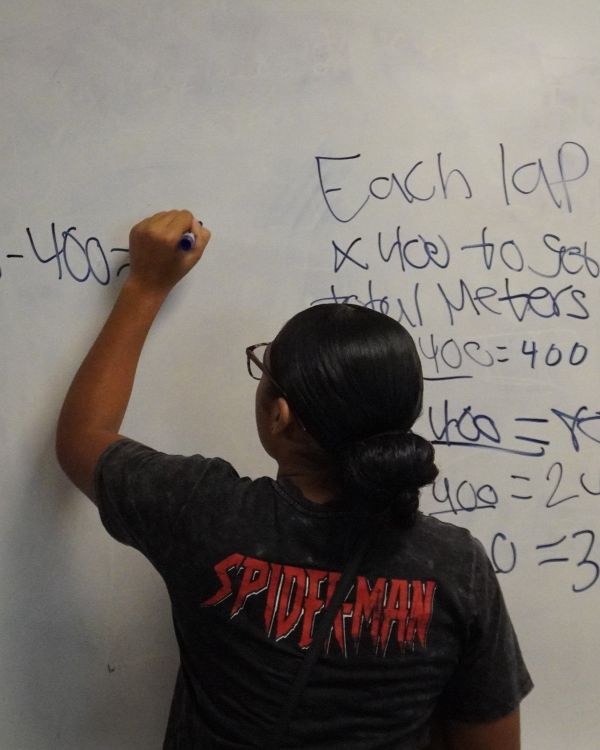
“In a traditional classroom, it was: here’s a new topic and here’s how you do it. Now practice it,” Bunton explained. “Ours is: we are not going to tell you what the topic is. We might give you a name, but not the conceptual reasoning behind it. You are going to explore and figure out how to do it and afterward, we put a name and definition to it.”
Bunton was instrumental in bringing BTC practices to Wyoming. She received a fellowship in 2022 as a first-year teacher to work with other teachers on math instruction, and through that work learned about BTC.
She and other district staff members have since done professional development through Kent ISD with a focus on BTC, and Bunton’s classroom has served as a learning lab for other districts. She also is involved in an international group of teachers who use the strategies.
Along with Bunton, several other math teachers at Wyoming High School are now using BTC, including department chair Nathanael Juliot, who teaches geometry and personal finance.
“It’s been a gradual shift, and a lot of us have started to really pick it up. As we’ve seen it happen in Bunton’s room, we’ve tried elements and sections of it,” Juliot said.
Eric Retan, who has taught math at Wyoming High School for 27 years, said he loves seeing BTC gain momentum.
“It’s contagious in a good way. The more you see the effectiveness of it and the shift in the class culture, the more you are willing to try more aspects of it,” he said. “For me, it’s really exciting because it matches the vision I’ve had for a while of what I want in my classroom.”
Math in the Real World
Juliot said he sees another important reason to shift away from traditional math instruction: it’s been more focused on getting the answers than the process, and now answers are at students’ fingertips.
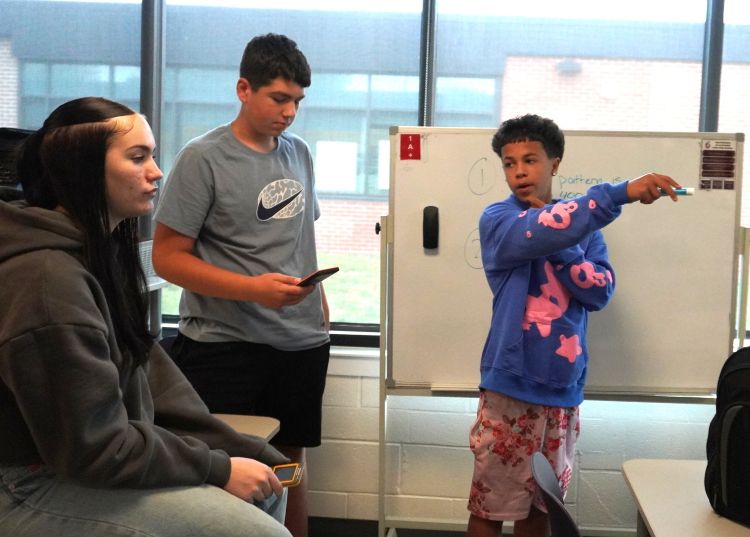
“Our department over the last couple years has really been adapting and changing to what the landscape is like in the world, with AI and things like that, because kids can go online and type in an equation and get the answer,” he said.
It’s also about relevance, Bunton said, repeating the timeless question, “When am I ever going to use this in real life?”
“Honestly, they probably won’t have to use the quadratic formula in their job or solve equations every single day, but it’s more about the skills we are getting them to engage in: problem solving skills, critical thinking, collaboration, being able to publicly speak about their learning,” she said.
‘It’s contagious in a good way. The more you see the effectiveness of it and the shift in the class culture, the more you are willing to try more aspects of it.’
— Eric Retan, 27-year math teacher
Geometry teacher David Warners’ class on a recent Tuesday worked in their groups of three on whiteboards.
Sophomore Jayden Washington jotted down work as he talked.
“We get to learn how other people think because there are many ways to get to one answer,” he said.
Warners is still getting used to the model, working to manage hands-on group discussion with teenagers’ tendency to get off task.
“I enjoy it when it works well and we have groups that are talking together about the math. I think if they are talking about it, they are learning,” he said. “There is something about being up at the board that creates more conversation.”
Read more from Wyoming:
• Family continues legacy of giving back through Poppy’s Closet
• School upgrades make for bright & fresh first day


