



Forest Hills — Emily Mechan understands that animal euthanasia is sometimes used, but she believes there are better alternatives — such as education and promoting animal welfare — to help reduce the pet population.
As the Eastern High senior prepared her first presentation on the topic for her Advanced Placement Seminar class, she said an expert like Amy Heddy, education coordinator at the West Michigan Humane Society, has been a valuable resource.
“It certainly helps clarify for me what direction I want to take with this presentation,” Emily said. “(Heddy) has provided one perspective within the field of animal rescues that I can utilize as I pull together my evidence to support my paper.”
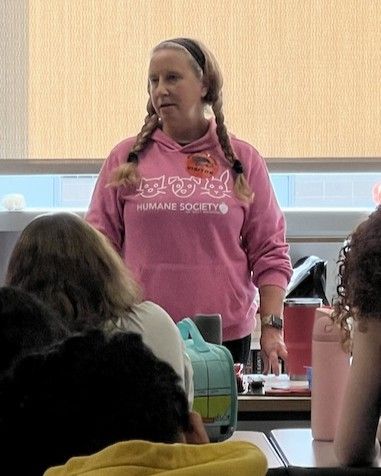
Heddy’s visit to AP Seminar classes came about because of Eastern’s National Honor Society supply drive for the Humane Society, said Doreen Barnes, who, along with Amber Ashley, teaches the classes.
Barnes, who also serves as the NHS adviser, said the group organizes a drive every year to support a local organization. When the need for supplies at the West Michigan Humane Society was brought up — and with NHS members discussing how shelters are currently full — Barnes said she thought it would be a meaningful first project.
In AP Seminar, students analyze information, build evidence-based arguments, and present them through research and collaboration. Barnes said the issue of rescues and overcrowded shelters presented a real-world problem that students could explore for their first research project.
Students were placed in teams of three to four students and given the topic, “How do animal shelters benefit communities?” As a class, they read articles and other research materials as they prepared a 45-minute oral defense for their topic, she said.
How One Dog Can Equal 100,000 Puppies
Heddy’s visit to the classes helped students recognize the value of using a primary source, providing authenticity and firsthand insight into the topic they’re researching, Barnes said.
The West Michigan Humane Society is a non-profit, no-kill shelter that mostly takes animal surrenders, Heddy told students, different from a municipality-run shelter, which focuses on strays. She said the Humane Society prioritizes education, because “the more we educate, the less community outreach is needed.”
As an example, she explained that an unspayed dog can have up to 20 puppies in a single year, and within six years, that dog — along with its offspring and their litters — could contribute as many as 100,000 puppies to a community. She noted that a single upspayed cat in about the same time frame could add more than 400,000 kittens.
Many students were shocked by the numbers; junior Hudson Webster called them “insane,” especially when thinking about how many dogs that really adds up to.
‘It helps to have a person come in who is a living example of what they are actually going through every day.’
— Eastern senior Reagan Thompson
Educating people and providing resources for residents to get their animals spayed or neutered helps to reduce the overcrowding in shelters, Heddy said.
The West Michigan Humane Society has a 96% live release rate, which are animals that are adopted, returned to their owners or transferred to other rescues. Because the Humane Society’s release rate is so high, it accepts animals from other areas like Detroit, which has a live release rate of 67%, and southern states like Tennessee, which has a live release rate of 87%, Heddy said.
Michigan has nearly twice as many animal shelters as Tennessee, 212 compared to 125, Heddy said.
“In the south, they will euthanize for space,” Heddy said. “So us taking six puppies from a shelter in the south means that there are six spots open for other dogs.”
Educating the Next Generation
The West Michigan Humane Society recently took in several puppies and a few young adult dogs from a Tennessee shelter. The puppies visited Eastern High for the supply drive as part of an effort to raise awareness about animal welfare.

“This is a pivotal time in your lives; you’re shaping who you’ll become and will be the ones driving future change,” Heddy told students. “As Generation Alpha, the more I can educate you about animal welfare and care, the better you will be able to make change in aiding pets and shelters.”
“After having listened to (Heddy), it makes me feel bad that so many shelters are having difficulty,” sophomore Tia Bhatia said, adding it also made her want to adopt a shelter dog.
Sophomore Cameron Conklin said Heddy gave valuable insight into the world of animal rescue, including how some people, despite starting with good intentions, can become pet hoarders simply because they struggle to say no.
Senior Reagan Thompson said she found the information on the mental health impact on staff and volunteers interesting, and how the Humane Society provides resources to help them.
“It helps to have a person come in who is a living example of what they are actually going through every day,” Reagan said.
Read more from Forest Hills:
• Opening students’ eyes to the connections to the world
• 3D ‘cabinets of curiosity’ represent a generation’s issues, stories


