


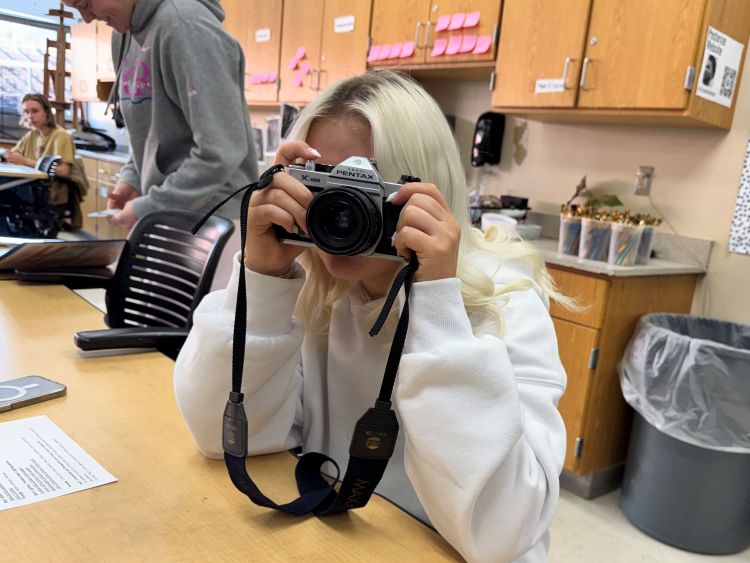
East Grand Rapids — The smell of developer and stop-bath, the infrared glow of safe lights, the slow, careful rolling of film onto reels — it’s all becoming commonplace for students in East Grand Rapids High School’s analog photography class as they learn their way around the darkroom.
Though darkroom photography technology may seem quaint and the process of developing film is laborious, the class at East remains a draw for students, and the fact that it’s still offered is a point of pride for teachers.
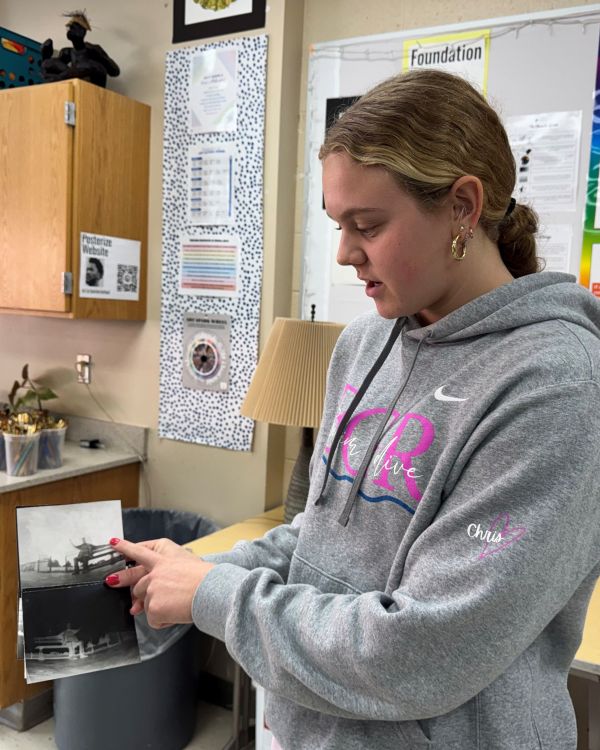
During a recent visit to EGRHS, junior Colette Kanngiesser, senior Ellery Chandler and a few of their classmates gave SNN a tour of the school’s darkroom setup, and talked a bit about what they’ve learned so far.
‘When they’re in the darkroom and they’re witnessing the emergent image on that light-sensitive paper coming through in the developer, that’s like real-world magic.’
— EGRHS teacher Terry Szpieg
‘It’s working!’
After knocking on the darkroom door to make sure it wasn’t in use, the students led the way into the space.
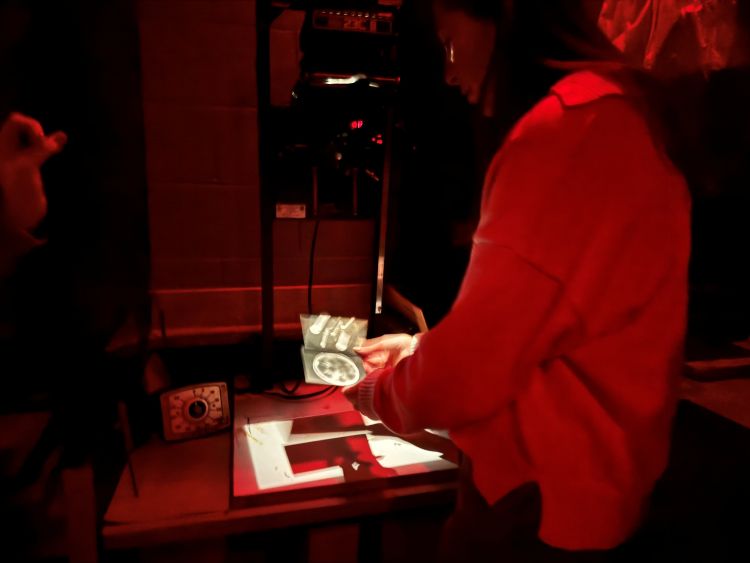
Once inside, they flipped a low-frequency light, which is safe for the photo paper, but not for the film itself. When actual film is loaded onto developing reels, students explained, it has to be done in total darkness in a separate, much smaller room adjacent to the darkroom space.
The students proceeded to ready the developer, stop-bath and fixer to develop a few quick images, including a cameraless photogram image. They also walked through the process of using an enlarger and various chemical baths to convert a negative image into a positive one.
“You’re supposed to, like, agitate the chemicals,” Colette said, dunking the photo paper in the developer. “In a few seconds you’ll start to see the darkness come through.”
Said Ellery, “I think it’s working!”
Colette said she has plenty of experience with photography, but it’s all been digital until now. Like most of the students, she’d never used a film camera or a darkroom prior to taking the class.
“I thought this would be really fun to, like, learn kind of an older side of photography, and be able to discover kind of how it started,” she said.
Ellery said she’d seen the work of past analog photo students, and there was something compelling about the feel of the images they created.
“One of my friends last year took the class, and she took a picture of me and my friend one day,” she said. “I later got the picture and I thought it was really cool. I was interested in being able to make more pictures like that one.”
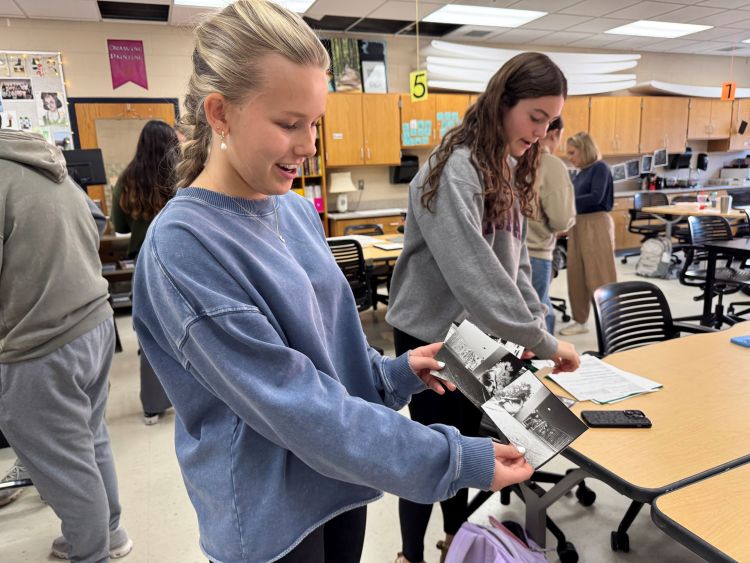
The students’ first taste of the process came from using small, lensless “pinhole cameras” they fashioned out of lightproof boxes.
“We put light-sensitive paper inside of it, then close it so it’s light-tight,” Colette explained. “Then we’ll go outside and hold it steady, and we’ll just open the ‘camera’ part, basically, for about 30-ish seconds depending on how sunny it is. Then we’ll close it, we’ll go in here (to the darkroom), take it out and develop our photo. It turns out really clear, and it’s really cool.”
The class is not without its challenges, though. For one thing, it’s tricky to get the camera settings right, Colette said.
“It really depends on the conditions outside, where you are, the sun, what you’re taking a picture of,” she said. “There’s so many different things that go into choosing how long you want to expose your film for, or how in-focus it is. It’s a lot of trial and error.”
Ellery concurred, adding that it was tough to figure out how much exposure was needed during the pinhole camera project.
“But there’s definitely been a lot of cool pictures that we’ve gotten out of it,” she added.
‘Real-world magic’
The year-long class is taught by Alison Maes, who said she wasn’t sold on it at first, because many of the supplies are hard to come by and there’s limited space. But now that she’s in her second year of teaching it, she’s come around.
“I’ve really grown to love it, and I would say it’s almost one of my favorite classes to teach now,” Maes said. “It’s just so … magical to see the process and to see them learn about it.”
Adding to Maes’ support of the program is the enthusiasm of fellow art teacher Terry Szpieg, who taught the class until Maes took it over.
Szpieg, a longtime champion of film photography who still helps out with the class in an advisory capacity, said darkroom photography is unique in that it offers students a chance to flourish in both creative and technical ways.
“There are components of both within that process of analog photography,” Szpieg said. “Those that find composing and setting up and creating visual imagery more appealing, and those that maybe find the work in the darkroom as their jam — working with the chemistry, doing the math to figure out exposure, seeing the result of that manifest in their prints.
“They’ve got to apply their science, their technology, their process in creating manifest images from that latent film.”
It teaches patience, too, he said, as the process takes time, attention and focus. It’s hard work, Szpieg said, but there’s an immense payoff to it.
“When they’re in the darkroom and they’re witnessing the emergent image on that light-sensitive paper coming through in the developer — that’s like real-world magic.”
Read more from East Grand Rapids:
• Beneficiary organization helps East family find hope
• Tree identification project will be used ‘for years to come’


