


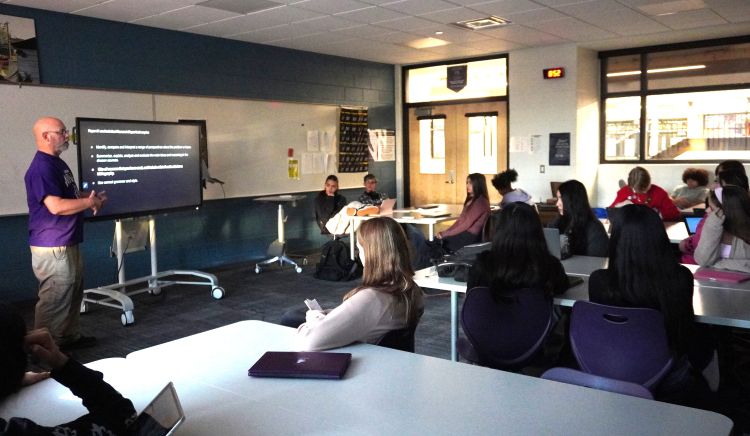
Multiple districts — In Wyoming High School’s AP Seminar class, students broke into groups to explore themes in the dystopian novel “Station Eleven,” preparing for their first presentation of the semester.
Their work was a “dry run” for the multimedia presentations they will create for the College Board later this year as part of their AP exam, said teacher Tom Cornell, who is in his third year teaching the course.
AP Seminar is one of several new Advanced Placement classes added at Wyoming High School in the past few years. The interdisciplinary course, which replaced Honors English 10 at Wyoming, involves research and writing to develop college-level skills. The first presentation on “Station Eleven” will give students an idea of what components they will need for final presentations on topics that address real-world issues, Cornell said.
The class is also giving more students a taste of what AP is like, and it’s one reason many are enrolling in other rigorous AP courses as well.
Wyoming High School is following a statewide trend of high schools offering more AP classes, and more students taking them. More are also passing end-of-year exams and earning college credit. The high school has more than doubled its AP course offerings in the past few years and has tripled the number of students taking the exams.
‘AP has a lot of benefits and I want to challenge myself more.’
— Brooklyn Wilson, Wyoming sophomore AP Seminar student
Other schools in Kent County are following that trend as well — adding a variety of classes including AP Seminar and working to make AP accessible to all students.
“Research shows students who take AP courses have an increased trajectory through college just by taking an advanced level course,” said Wyoming High School Assistant Principal Rhonda Varney, a former administrator in Chicago Public Schools, where she also worked to grow AP offerings.
Increased academic success is true even if a student doesn’t score a 3 or above on the exam, she added.
“Knowing that taking a rigorous course is going to benefit them in the long run, (we wanted) to open up access to that.”
Statewide, the number of students taking AP courses and performing well on the exams reached a record high last school year. According to information from the Michigan Department of Education, 65,906 Michigan students took one or more AP exams in 2025, up 4.5% from the year before, when 63,053 students took at least one of the tests, and an increase of nearly 15,000 students from four years prior.
Students took 118,219 AP exams in 2025, an increase from 110,901 in 2024. Of those, 49,708 students scored 3, 4 or 5 on a scale of 1-5 on AP exams, which means they are designated qualified, well-qualified or extremely qualified. That’s an 11.2% increase from 44,711 in 2024. A score of 3 or above often qualifies students for college credit depending on what college or university they attend.
At Wyoming, sophomore AP Seminar student Brooklyn Wilson said she plans to take more AP courses including AP History next year, “honestly for the college credit. AP has a lot of benefits and I want to challenge myself more.”
As for AP Seminar, she said, it’s a good start.
“The work is pretty easy. It’s not overwhelming. You kind of just have to stay on top of everything.”
Expanded Access, More Options
Since 2021-22, Wyoming High School has increased its AP course offerings from six to 13 with plans to add more. And the number of exams taken has increased from 107 in 2021-22 to an expected 387 this spring. The number of students scoring 3 or higher and earning college credits has increased from 38% to 52% over those years as well.
Varney said staff started using the AP Potential tool to identify students who show they are likely to have success in AP. Varney also met one-on-one with them.
“We started to recruit students that way, just to inform them and their families about the courses that exist,” she said.
Added Principal Josh Baumbach: “We are trying to provide students as much opportunity as possible to take advanced level coursework. Sometimes students need to hear that they are capable. They need to have that reassurance.”
At Kelloggsville High School, which has an enrollment of about 600 students, Principal Nick Patin credits AP Seminar with building students’ interest and confidence. Kelloggsville offers 10 AP classes, up from four three years ago.
Last school year, 134 students took at least one AP course and took a total of 186 exams. The pass rate of 40% was an increase of 7% from the year before, Patin said.
“We have seen an increase due to every student taking AP Seminar as their 10th-grade English selection,” he said “We find this allows students the opportunity to see that they are capable of AP, which gives them the confidence to take other AP classes in their junior and senior years.”
Grand Rapids Public Schools has also increased its AP offerings. There has been a 28% increase in tests taken from 2023 to 2025, with 100 more students taking them. Across its 11 high schools and high-school programs, GRPS offers 18 AP courses. Grand Rapids University Preparatory Academy requires AP Seminar for all 10th-graders in place of English 10.
“All the buildings have been growing, with more and more students taking them every year and more courses being offered,” said Amy Powney, district coordinator for Advanced Placement.
Continuing to Grow
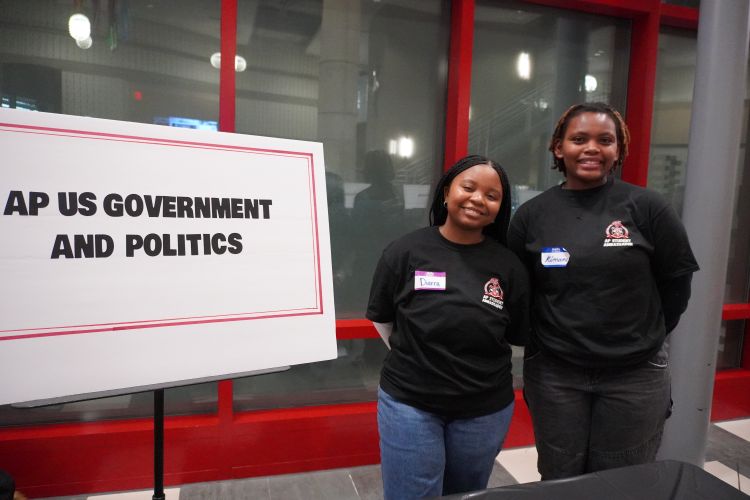
In Kentwood Public Schools, AP Coordinator Molly Mosketti has continued to help build a robust AP program. She is hoping to get as many eighth- through 11th-graders as possible to attend the third annual AP Night from 5:30 to 7:30 p.m. Thursday, Nov. 13 at East Kentwood High School. The event, led by 40 ninth- through 12th-graders serving as AP ambassadors, provides a showcase of AP courses and what they are about.
East Kentwood High School offers 24 courses, up from 17 in 2019. The number of students taking courses and the number of exams taken increased by about 90 percent. That year, 465 students took 895 exams. Last year, 935 students took 1,747 exams at the approximately 2,800-student school. In 2019, EK had about a 56% pass rate, and last year, 57%.
“It would be something if we were adding a bunch more courses and our pass rate dumped, but it actually increased,” Mosketti said.
Mosketti said her personal trajectory was changed by taking AP Calculus in high school. In college, she took calculus again and many other students came to her for help.
“I felt like just the smartest kid in the entire class. I think that is why I became a math teacher,” she said.
Mosketti said continuing to build awareness and a sense of belonging around AP is key to future growth. Though about 32% of students are taking AP courses, that means 68% are not, which doesn’t necessarily align with students’ goals.
‘Students need to hear that they are capable. They need to have that reassurance.’
— Wyoming High Principal Josh Baumbach
“The statistic right now is that close to 90% of our students identify that they want to go to at least a two-year if not a four-year university, so if that’s the case, (we need to identify) what would be the readiness factor or barrier preventing them from taking an AP course?”
EK is partnering with a company called Equal Opportunity Schools to help answer that question. As part of that, students create insight cards that give counselors and teachers ideas of their education and career goals and interests. The cards also include names of teachers who have indicated the student would do well on an AP level course.
Another focus is diversity of students taking AP courses. Statewide, several demographic groups have increased participation in AP and performance on exams, according to the Michigan Department of Education.
While AP enrollment is diverse at EK, Mosketti said, it doesn’t quite match overall enrollment: 26% of AP students are Black, compared to 37.1% in the school; 14% are Hispanic compared to 17.4% school-wide; and 29.1% are white compared to 23% overall.
At Wyoming, the makeup is also diverse, but also isn’t an exact reflection of school-wide enrollment: 38.2 percent of AP students are Hispanic, compared to 53.5 percent in the school; 12.2 percent are Black, compared to 14.4% in the school and 44.3 percent are white, compared with 23.5 percent in the school.
“We are trying to make sure that the population of our hallways matches or is at least very close to the population of students that are in our AP programming,” Mosketti said.
Mosketti said she sees AP as part of the big picture for thriving communities. Students with success in academics and careers often return to their communities to invest their talents, or do so in new communities.
“We are still focused on making sure that if our students want to be college-driven we are offering those opportunities to them. And a higher percentage of students getting a 3 or higher on their AP exams means they have fewer college bills to pay (and) a head start to a degree.”
Reporter Joanne Bailey-Boorsma contributed to this story.
Read more:
• Over 13 years, middle college has launched hundreds of high-schoolers toward degrees, careers
• Engineering classes help students explore careers, earn certification


