


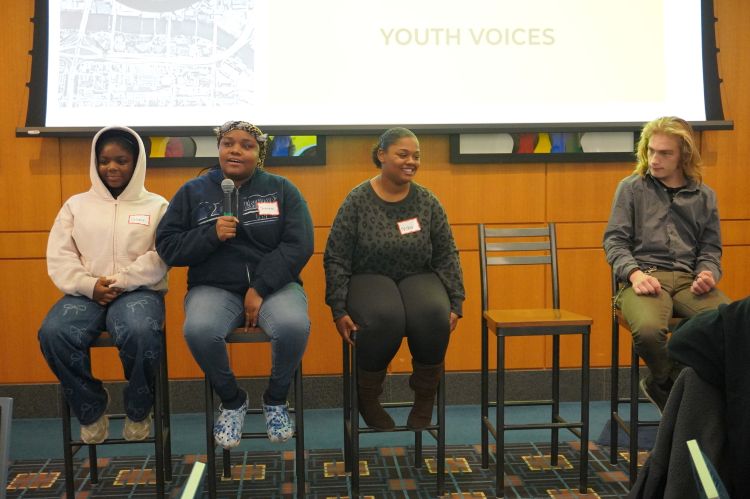
All districts — Shantae Thompson, a young woman who has faced homelessness in Grand Rapids, said she hopes people will care when they think of youth who lack stable housing.
“That’s the word of the day,” she said. “I want them to care more about youth homelessness. I feel like there are not enough organizations that support youth (in) homelessness. … You can walk outside right now and see, like, 10 homeless people.
“Most shelters don’t want to take them because of such and such, but everybody needs a home. Everybody needs a helping hand. Shouldn’t nobody be on the street.”
Shantae spoke on a panel of four young people who shared personal experiences with homelessness during the recent event “WE EXIST: The State of Youth Homelessness” at Grand Valley State University’s Seidman Center.
Her words were heard by more than 100 community representatives who serve nonprofits, education and public safety.
The event, hosted by AYA Youth Collective, The Grand Rapids Area Coalition to End Homelessness, Arbor Circle, Covenant House and Kent ISD aimed to raise awareness, share data, and ignite action to end youth homelessness.
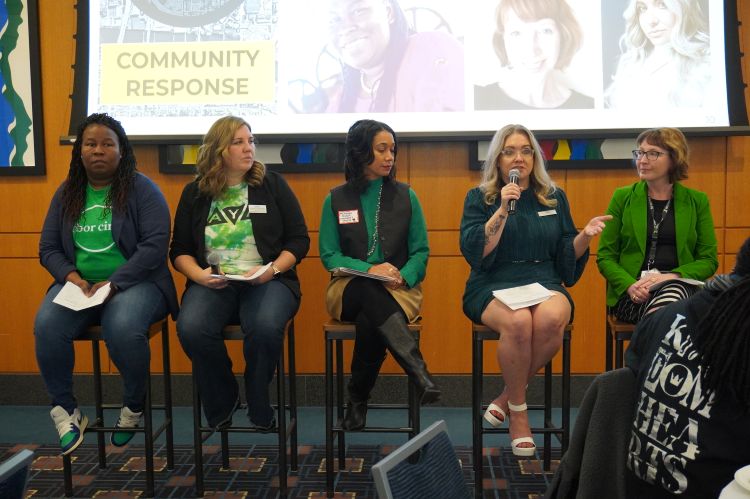
According to information from the Homeless Management Information System used by the Grand Rapids Area Coalition to End Homelessness, more than 350 young people in Kent County have slept outside or in emergency shelters in the last three months — a number that is much larger now than pre-pandemic, said Lauren Garmelin VanKeulen, CEO at AYA Youth Collective.
“We believe the community has the resources to end youth homelessness. That is going to take all of us coming together,” she said. “We don’t think any 19-year-old should be sleeping outside.”
Action steps shared to prevent and end youth homelessness include volunteering, donating, making available studio, one- and two-bedroom units for youth to lease, and remaining involved.
Working to Identify Youth
Organization leaders also spoke of the increasing need and made calls to action, sharing the Youth Homelessness Demonstration Program’s Coordinated Community Plan, created by a local youth advisory board, to end homelessness.
Casey Gordon, Kent ISD special populations consultant, said last year in Kent County, 678 high-schoolers were identified as experiencing homelessness and one-third of them were on their own, without a parent or guardian.
“We also know that is an undercount,” Gordon said. “We are not identifying everyone we could and should be. That is why we work so hard with our Continuum of Care and with the partners on this panel and in this room on outreach, so youth know there is somebody who can help them have school stability and access resources.”
‘Everybody needs a home. Everybody needs a helping hand. Shouldn’t nobody be on the street.’
— Shantae Thompson
Courtney Myers-Keaton, director of the Grand Rapids Area Coalition to End Homelessness, said a goal is to make sure all youth in housing insecurity know where to access help.
“Youth can experience homelessness differently: they are couch surfing, they are in and out of spaces,” she said. They don’t always want to access the same traditional resources that older adults do, so sometimes our numbers look a little bit lower than we know actually exist out there.”
Keaton said young people are experiencing homelessness longer — an average of about three months — due to the lack of affordable housing and rising costs.
What Youth Have Experienced
Youth panelists talked about factors leading up to homelessness such as unemployment and aging out of foster care.
They recommended having more events to address youth homelessness, opening more shelters, building awareness and encouraging understanding as ways to help.
“Talk about it at dinner. Find solutions,” said panelist Mike Redding. “Talk about it with your kids. The ones close in age with your kids are the ones you are trying to help. The key takeaway of this event is to step into our shoes and then take a step back to look at it.”
Read more:
• Student homeless numbers increase, future funding uncertain
• Summer outreach connects families facing housing insecurity with resources


