


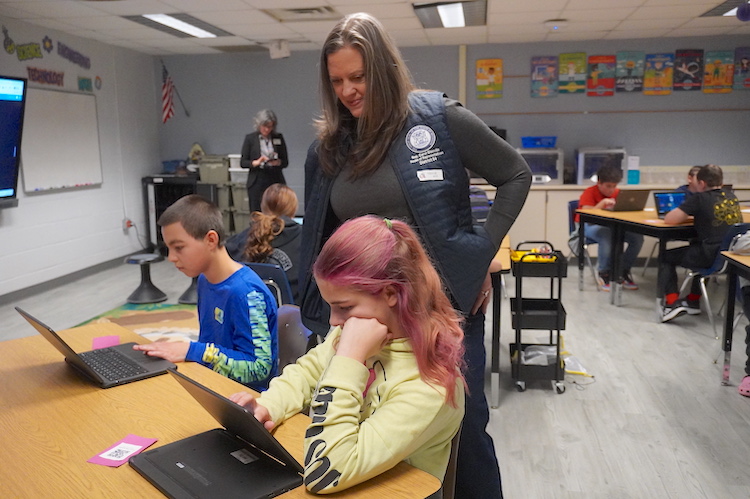
Kent City — To teach his AI robot how to tell the difference between a fish and trash, fifth-grader Aiden Austin carefully classified items on his computer screen as fish or not fish.
After identifying about 30 fish and random items, Aiden ran a program to test how well he had trained the robot, watching as it sorted the fish from trash.
“AI made a few mistakes,” he said as he looked over his results, which displayed a page of brightly colored fish with a couple of plastic six-pack can rings. “I have to keep training.”
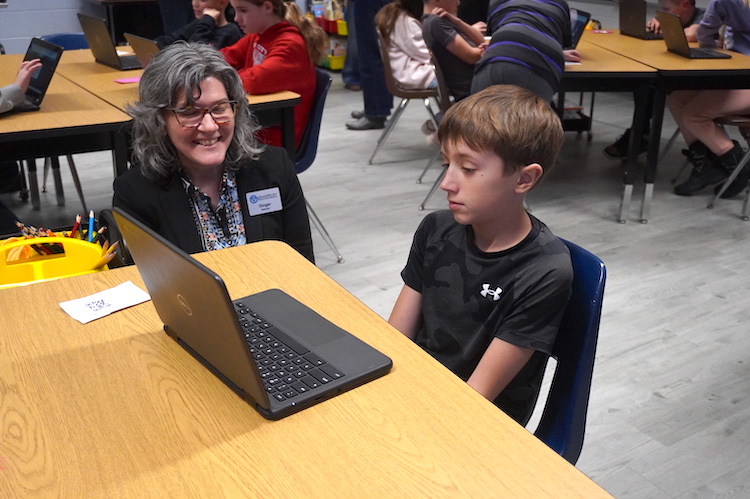
Aiden and his classmates were among about 25,000 students across the state who participated in The Hour of AI, a classroom experience focused on artificial intelligence to mark Computer Science Education Week, which was Dec. 8-14.
Area policymakers were invited to the interactive event at Kent City Elementary School, where they saw firsthand how schools are integrating meaningful, developmentally appropriate AI education into STEM and computer science curricula. Attending were State Rep. Carol Glanville and Kent County Commissioner Elizabeth Morse.
Over the past several months, the Kent ISD EdTech team has partnered with Kent City Community Schools’ AI Steering Committee to support a thoughtful approach to AI adoption, including a district-wide toolkit and professional learning focused on AI literacy, ethics, fluency and development, according to district officials.
“At Kent City Community Schools, our AI Steering Committee is committed to ensuring that artificial intelligence enhances, not replaces, the human connections at the heart of teaching and learning,” said Superintendent Bill Crane. “By approaching this work thoughtfully and collaboratively, we are building a framework that empowers educators, strengthens instructional practice and keeps student needs at the center.”
One Fish, Blue Fish, Not a Fish
As part of the Kent City Elementary exploratory curriculum, students participate in a weekly STEM class. In fifth grade, students explore 3D printing and design using a computer-aided design program.
Although many of the 24 fifth-graders participating in the Hour of AI had encountered AI before, it was their first experience learning how it actually works and is trained.
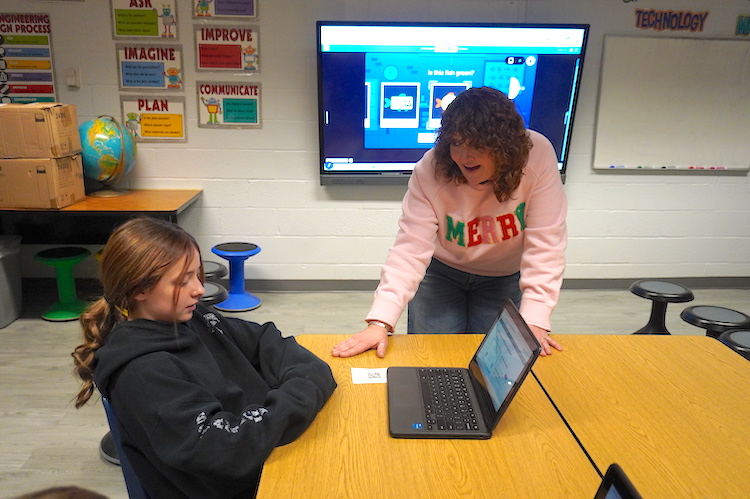
“What is artificial intelligence?” teacher Nicole Andreas asked the class. When there was no response, she then asked, “What is an artificial tree?”
“A fake tree,” a student answered, and Andreas responded, “Correct. So artificial intelligence is fake knowledge.”
Andreas explained to the students that for a computer to know what to do, a person has to teach it, which would be that day’s task. Students went to code.org and participated in a lesson called “AI for Oceans.”
The lesson is divided into four parts, with each section building on what the students teach the computer. Andreas explained that the goal was for students to understand how an AI system learns, examine the training data it uses and explore how AI could be applied to address an ethical issue such as cleaning waterways.
In the first section, students taught the difference between fish and trash by identifying fish. Then they identified what belonged in the water and what did not.
“How does your brain know that something is trash?” Ginger Rohwer, director for the Greater West Michigan MiSTEM Region, asked a student. “Just as you learned what trash is, so does an AI robot.”
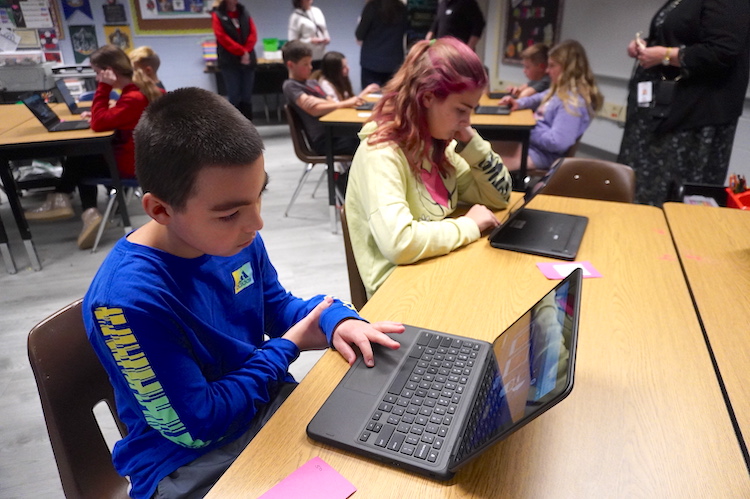
In the third lesson, students chose either a color or a shape and trained the AI robot to select only the fish that matched their choice. This proved to be challenging for those who selected a color, such as Aiden, who selected blue. The fish could be all blue, have a blue body or just blue fins.
“I decided that the fins are part of the fish’s body,” Aiden said as he sorted the fish. “If they have a blue fin, then I am counting them as a blue fish.”
Classmate Sierra Cross said she had an easier time because she chose a shape, the circle, which made it simple to sort the fish, as they only had one shape.
Is That Fish Happy?
The final lesson was to sort the fish by a feeling, such as happy, hungry, scary or silly. It was not an easy task, said fifth-grader Addison Nouser.
“It was hard to tell if a fish that had a smile was happy, because its eyes could appear like it was not,” Addison said.
Andreas explained that this is called bias, which happens when a computer makes an unfair decision based on the information it is given. She said that if the person training the system only defines a smile as a sign of happiness, the AI robot might incorrectly identify a fish as not happy just because it has only a partial smile.
Glanville, who has a background in technology and education, said the classroom visit offered a close-up look at what students are learning and how they are applying those skills.
“The technical skill is so important,” she said, noting that programs like the one in Kent City not only teach about AI and technology, but empower students to think critically, solve problems creatively and lead with integrity.
“AI is here, and we can’t avoid it,” said Glanville, who vice-chairs the School Aid and Department of Education Appropriations Subcommittee. “Helping students learn how to use it not only aids in navigating it today, but how it is used in the future as these students learn about and explore careers in the field.”
Read more from Kent City:
•New art classroom invites ‘productive artistic work’
•Fourth-grader teaches peers about living with diabetes


