


Forest Hills — “Welcome to the view from my office window,” said Forest Hills bus driver Mikal Bos as her bus turned from Pettis Avenue onto Fulton Street, the sunrise bursting open across the morning sky.
“You’re driving down in the morning and you see all the oranges and reds — pretty, pretty colors. A little bit later you get blinded by the sun,” Bos said with a laugh.
It was about 7:30 a.m. on an early winter morning, and Bos had agreed to let School News Network ride along on her route to offer a firsthand look at what a bus driver’s job is really like.
“I certainly hope that by having someone see what it’s like on a bus, it will encourage more people to become bus drivers,” said Forest Hills Transportation Director Brenda Witteveen.
A bus driver shortage has forced several districts, including Forest Hills, to cancel runs. At the start of the year, the district was short 12 route drivers, requiring it to combine two routes, Witteveen said.
School districts in Michigan are not required to provide transportation for general education students — only for those in special education. But in a district like Forest Hills, which spans both rural areas and growing developments, roughly half of its approximately 9,000 students rely on district-provided transportation to get to and from school. The district contracts with Dean Transportation for its special-education students.
It means bus drivers like Bos are often the first district staff to greet students every morning and the last to say goodbye at the end of the day.
Early Morning Start
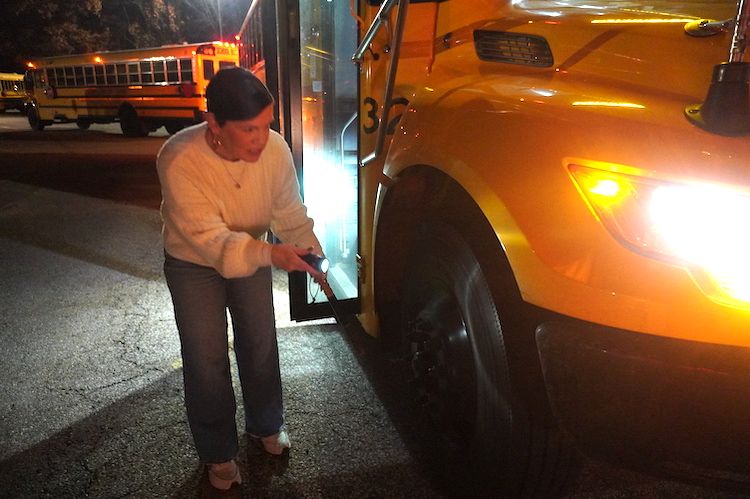
Bos arrived at the bus garage around 6:15 a.m., grabbed her keys and headed to bus 32. She had about 15 minutes to complete her checks before starting her first route for middle- and high-school students.
She tested the air brakes, door and lights, started the bus and logged everything into My Ride K-12, the system that also provides route maps and tracks students boarding and exiting. She then walked around the bus, using a baton to check tire pressure and looking underneath for leaks. With safety checks done, she pulled out around 6:30 a.m.
“When you drive the same route every single day, you learn a lot of fun things, like this light will turn green at 6:50 a.m.,” Bos said as she came to the intersection of Knapp Street and Pettis Avenue. “If I am early, I will pull over on the side of the road where that yellow gate is (she pointed to a gate along Knapp Street), and I know if I leave that spot at 6:46 a.m. I will make this light at 6:49 a.m.”
To become a bus driver, individuals must complete a 21-hour beginner school bus driver training course, hold a valid chauffeur’s license, and obtain a commercial driver’s license with passenger and school bus endorsements. Drivers are also required to complete a six-hour continuing education course every two years.
Although it may sound like a lot, Bos said the real barrier isn’t the training itself, but the assumptions people make about what driving a bus entails.
“I think for most people, they envision a certain kind of crazy,” Bos said. “That, or they have seen cartoons where there is paper throwing and similar stuff.”
The bus grew noisy with so many students, and Bos sometimes reminded them to keep the aisle clear and stay seated, but the riders were respectful.
Bos has been driving for Forest Hills since 2013, first as a substitute driver and then a route driver.
Forest Hills has 55 drivers with commercial driver’s licenses, which includes route drivers, substitute drivers, fleet mechanics and office staff. Having the entire team with CDLs provides some schedule flexibility, Witteveen said.
“I was scared to drive that big yellow thing,” Bos said with a laugh, but a test drive in another district showed her it wasn’t that hard, and she eventually fell in love with it.
The job also has become a way to connect with students, Bos said, adding she has been invited to baby showers and graduations.
Providing Some Magical Fun
”Kids are fun,” Bos said. “They don’t judge you on stuff like what you are wearing. I get to wear fun clothes all the time. I wear fun, different goofy earrings and winter Christmas shirts and Halloween costumes.”
For the record, yes — she does wear a Mrs. Frizzle costume for Halloween.
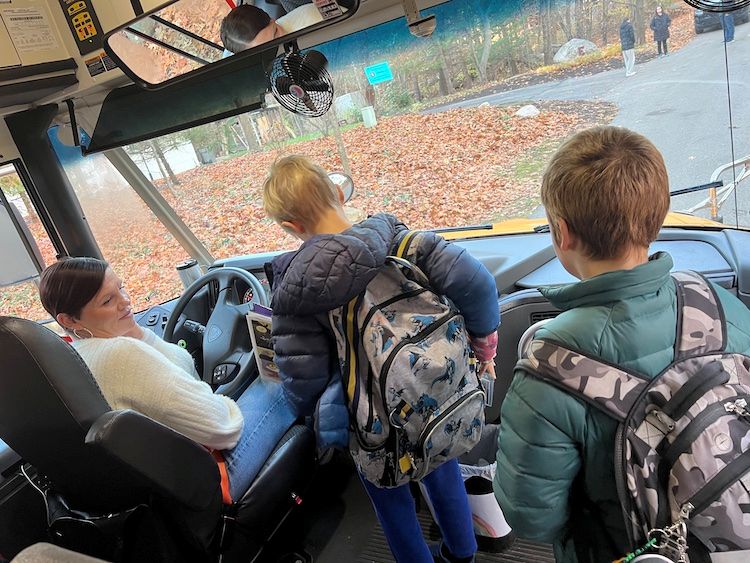
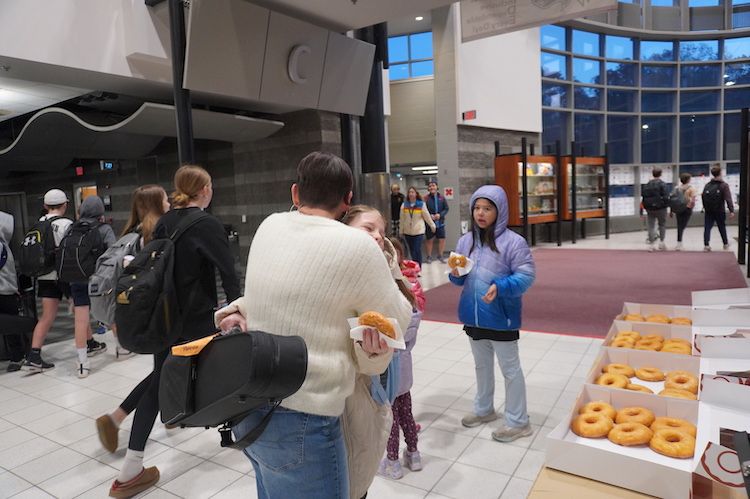
Just like Mrs. Frizzle, she greets every student by name as they get on the bus and tries to make the ride fun, especially on her elementary route, where some students spend nearly an hour on the bus. Witteveen said the long ride is due to Bos’ route incorporating part of a discontinued route.
Bos has students pass around a box of stickers, and leads games like “Would you rather?” with kids eagerly chiming in with ideas.
“Would you rather be a shark or a dolphin?” one student shouted, with another offering, “Would you rather be a raven or hawk?”
A little after 7 a.m., Bos pulled up to Eastern High School. In addition to her middle- and high-school students, she also transports a few Ada Vista Elementary pupils. Because schools such as Ada Vista, a Spanish-immersion school, and Goodwillie Environmental School draw students from across the district, those students ride on middle/high school routes.
Bos’ is one of the first buses to arrive at the high school, which is intentional, as she has one of the longer elementary routes. She has a short break before heading back out, which she uses to make sure her transfer students are settled and for a quick bathroom stop.
“It’s go, go, go the whole time I’m on the route,” she said, especially for the elementary route because of the number of stops. She will transport about 200 students: 100 in the morning and again in the evening.
Bus Driver’s Guide to the Rules of the Road
It’s all about timing, Bos said. Drivers are expected to be at stops by specific times.
“When they added routes to my schedule, I told parents they were going to need to check the (My Ride K-12) app for times,” Bos said. “Some of the parents told me that they had it, but had never used it because I am always there at 8:15 a.m. They could set their watch to it.”
As she drove, Bos explained that when buses use yellow lights and pull off the road, drivers can go by, whereas red lights mean a full stop. “Lights up top, come to a stop; lights down low, go by slow,” she said, noting that only the red lights are on top.
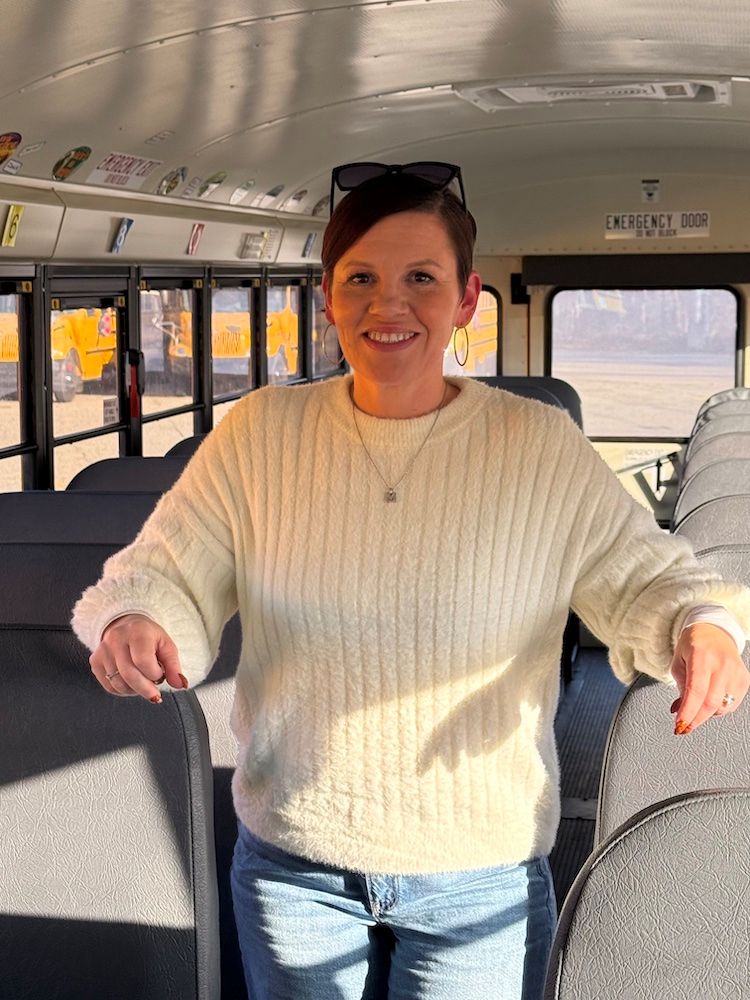
She added that while some drivers run the reds, she’s more worried about those who miss that other cars have already stopped — something she’s seen cause chain reaction crashes. On her rural route, she also has to watch for deer.
“Snow is not so much a problem, as it actually makes everything easier to see, especially early in the morning when it’s dark,” she said, noting she often finds out about a snow day the same time everybody else does.
The bus finally arrived at Knapp Forest but it was not the end of the morning run, as Bos had a shuttle run for a work-based learning program.
She arrived back at the garage around 9:30 a.m., then had about four and half hours before returning for her afternoon route.
Recognizing the gap can be an obstacle for some potential drivers, Forest Hills offers cross-training opportunities in food service or parapro duties to fill the gap, along with flexible schedules for those who prefer mornings or afternoon routes only.
Bos uses her gap time to work her own cleaning business. She will return around 1:55 p.m. for her afternoon route, finishing a little after 5 p.m.
It’s a long day, Bos admitted, but the rewards are worth it.
“It means a lot to me that I make such a good impression on kids that they want to stay in touch.”
Read more from Forest Hills:
• Humane Society brings animal welfare lessons to the classroom
• Lions, tigers & learning: class goes to the zoo


