


All districts — Local education leaders are advocating for a weighted school funding formula to better serve the needs of diverse students.
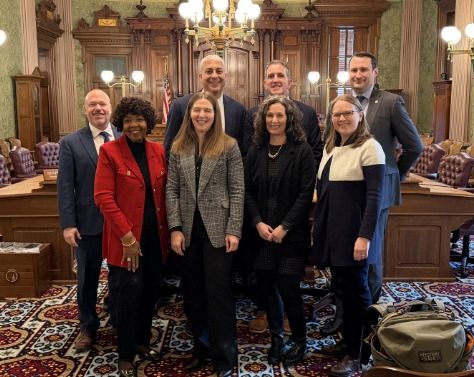
Kentwood Public Schools Superintendent Kevin Polston and Education Advocates of West Michigan Executive Director Dan Behm joined a group of policy leaders who gave testimony Jan. 27 during a Senate PreK-12 Appropriations Subcommittee hearing in Lansing. The group is calling for a change in the way schools are funded that would embed extra funding into per-pupil allocations for students who cost more to educate due to a variety of needs. (Watch the hearing here.)
“We are looking for a more flexible and efficient model (of funding) that can allow districts to have the long-term planning stability and predictability that are necessary,” Polston said.
Other speakers at the hearing included Megan DeKracker, chief of external relations for National Heritage Academies; Jeff Cobb, director of government affairs for EdTrust-Midwest; Alice Thompson,co-chair of the Michigan Partnership for Equity and Opportunity; and, from Education Policy Innovation Collaborative at Michigan State University, research specialist Jason Burns, Faculty Director Madeline Mavrogordato and Managing Director Emily Mohr.
“We know that students come to us with all sorts of different needs, and they are variable,” Behm said during the testimony. “How do we address those different needs in order to get to a universal outcome where all of our students have the knowledge and skills to not only be successful, but to thrive as adults in this dynamic economy?”
‘We’ve seen significant changes in (students’) demographics, including the degree of at-risk, special education and English-learners.’
— Kentwood Superintendent Kevin Polston
The group proposed a 10-year roadmap for fully implementing a weighted formula that would assign a base, per-pupil dollar amount to every student. Additional weighted funding would be added for students needing extra resources, such as those with disabilities, low-income backgrounds, or English language learners.
Currently, Michigan provides a base per-pupil allocation of $10,050 annually for students and also uses an Opportunity Index, which provides extra state aid to school districts based on their concentration of poverty.

But while the state’s last few annual budgets have increased funding for students and invested in various district needs, funds for English learners, special education and other groups have come in the form of “categoricals,” or funds restricted for specific purposes. A weighted formula would help keep funding more predictable from year to year and not be subjected to the whims of politics, Polston said.
The educators who testified in Lansing used findings from the School Finance Research Collaborative, which in 2018 determined the true cost of educating students and demonstrated that students with greater needs cost more to educate. For example, an at-risk student costs 35% more to educate, an English learner 35% more, and a special education 90% more than a student without extra needs, according to information the group provided.
They took those results, adjusted for inflation to today, and applied 3.2% inflation over the next 10 years. What they discovered is that the true cost for educating a student starts at $12,295 as a base foundation, more than $2,200 over the current per-pupil amount given by the state, according to data they presented.
“(The SFRC) said student needs determine what the students should be funded at, because their needs are different,” Polston said. “So, they recommended certain weights for English learners, students with disabilities, students that are economically disadvantaged, as well as isolated districts, career and technical education as well.”
Funding Needs Modernization

A new school funding formula would usher in a “new era,” in Michigan funding that modernizes Proposal A, passed in 1994 to make funding equitable in districts statewide, Behm said.
A lot has changed globally in the past three decades, and funding needs to address those changes, Polston said.
“We’ve seen significant changes in (students’) demographics, including the degree of at-risk, special education and English-learners,” Polston said, citing data from MI School Data. “Students with disabilities have grown by almost a third; at-risk students have nearly doubled; English learners have grown by more than 100%.”
Demographics have shifted even more profoundly in Kentwood, the most diverse school district in the state.
“In Kentwood, in the last 15 years, our at-risk population has grown by 43% and our EL population has grown by 160%,” he said, citing MI School Data. “Yet we are still using a model that was designed for a very different purpose — to equalize student funding in the state of Michigan.”
Weighted funding formulas have been implemented in states including Alabama, Colorado, Mississippi, Massachusetts and Tennessee, the educators said in Lansing.

In Michigan, students are not achieving results at the level expected despite significant investments in education, according to information from the group. According to MI School Data, 38.9% of students in the state were proficient in reading and 42.7% were proficient in math at the end of third grade.
Behm told lawmakers, “The research is very clear on this: When we identify the need and we respond with evidence-based practices early and robustly, we see the most effective outcomes in terms of the students’ performance, and we see the most economical outcomes in terms of taxpayer investment in meeting those needs.”
Polston said these education leaders plan to participate in future hearings and continue to advocate for the funding change.
Read more from our districts:
• How one teacher helped students beat national reading averages
• New model provides common language for emergency response in schools


