


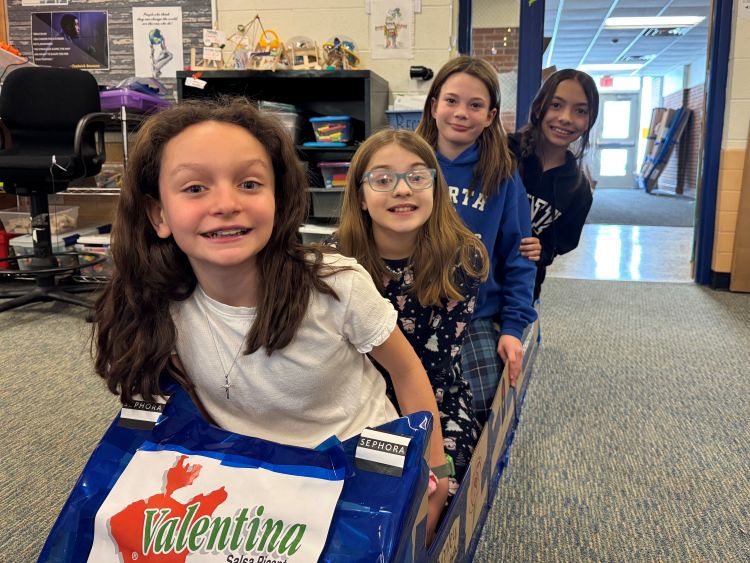
Sparta — Just in time for the Winter Olympics, students at Appleview Elementary got a taste of what it’s like to zip down an icy track in bobsleds of their own design.
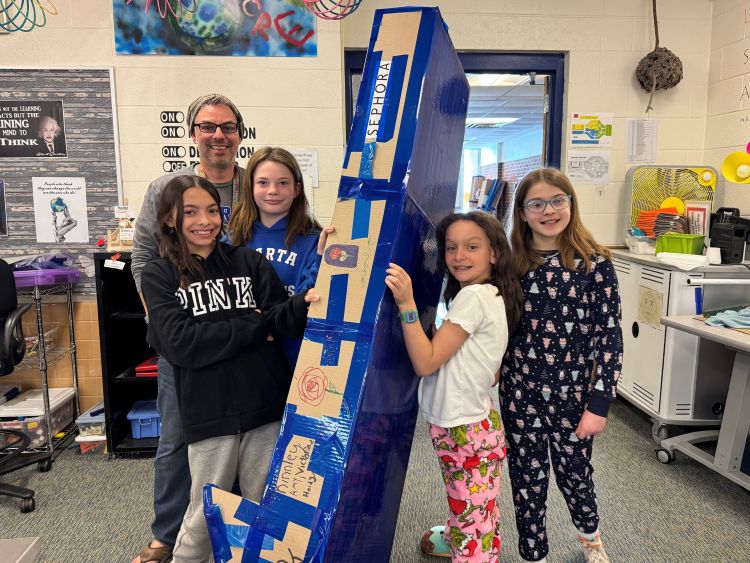
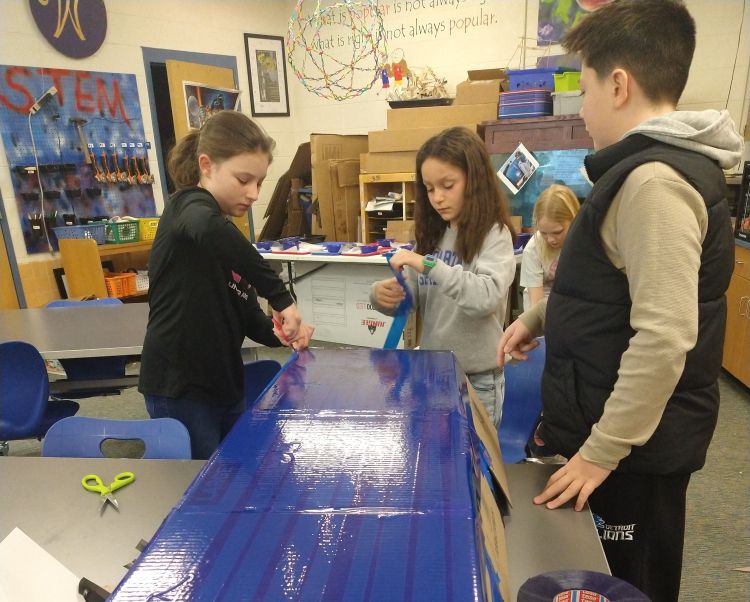
Fifth-graders in teacher David Oudbier’s STEM classes spent time in January and early February working together in small groups to plan, design and build their own bobsleds using only cardboard boxes, tape and their own imaginations.
The bobsleds had to have room to fit each group of four students, and they had to have an aerodynamic shape, with an angled nose to cut through the wind.
‘We’re a very technology-age generation. So, kind of stepping away from that and just being able to manipulate, with simple things like cardboard and tape, is so essential.’
— STEM teacher David Oudbier
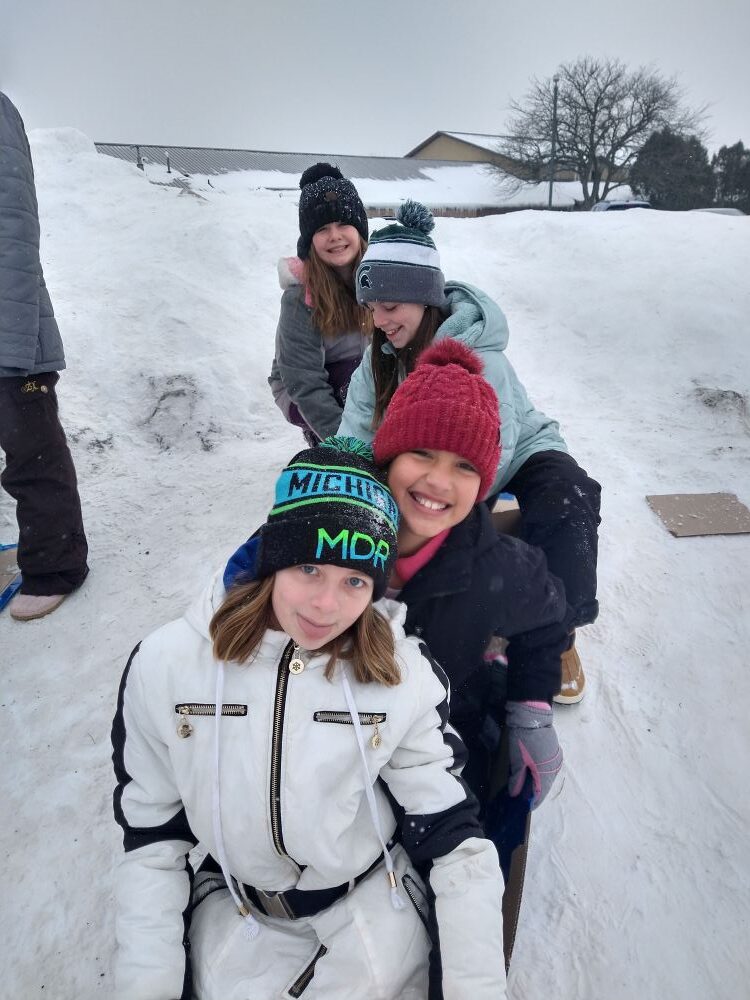
Once the bobsleds were built, students took them outside and tested them out on a hill near the elementary school building, seeing how many trips they could complete before their sled fell apart.
“What it was, was, basically, sled until your sled is literally nothing,” said fifth-grader Lily Stevenson.
Applying the Concepts
There were a lot of factors to consider during the building process: friction, motion, force, drag, gravity, aerodynamics and more, not to mention how to make the sleds sturdy enough to get down the hill in one piece while holding four students.
“We were given a cardboard box — a large cardboard box — and then unlimited tape to build this to fit four people to sled,” said Lily, who explained that there’s a lot riding on how the tape is placed on the bottom of the sled.
To maximize speed and minimize friction, tape should be placed lengthwise — not side-to-side — from the front to the back of the sled’s underside.
“One reason to do that is so your sled can go a lot faster. Another reason is so that the cardboard is protected,” Lily said.
She said the tape strips have to be as long as the length of the sled to avoid unnecessary friction.
Classmate Natalie McCracken said getting the tape just right was one of the trickiest parts of the assignment.
“The hardest part, in my opinion, was taping it up so it would stay and not break or rip off,” Natalie said. “Also, when you tape up the front, you have to try to make it angled. That was hard because you have to do it so all your teammates (don’t) fall out at the beginning.”
Despite all these considerations, the students — including Lily and Natalie, and their classmates Haven Frick and Raelyn Rasch — said they had a blast once they actually got their sleds out onto the hill.
They learned a lot as well.
“I didn’t know what a bobsled was until we started the project, and it’s really interesting, actually,” Haven said. “You have to reduce friction, and with each turn, you can’t go too high or when it falls down you’re going to fall on your side. But if you go too low, you’re going to go too slow. It’s really fun to do.”
A highlight for Raelyn was getting to work with her friends and see how they tackled the challenges of the assignment.
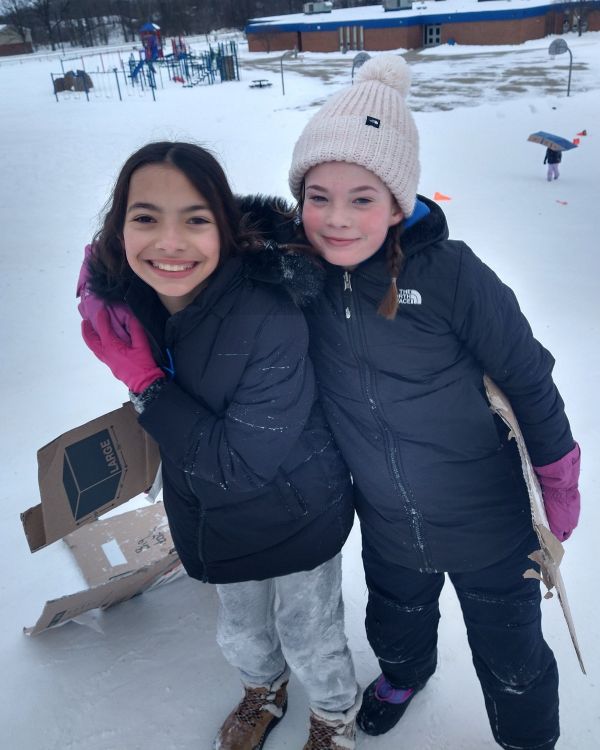
“And it was really cool to see other people’s ideas. Everyone’s were just different in their own ways,” Raelyn said.
Hands-on STEM Experience
Oudbier first introduced the bobsled project during the 2022 Winter Olympics in Beijing, but it’s become an annual project because it ties in so well with key STEM concepts like engineering.
He said the project has other benefits as well. It gets kids communicating and working together to solve common problems and achieve a common goal.
It also gives them critical hands-on engineering experience.
“I think a lot of students don’t use their hands as much anymore,” he said. “We’re a very technology-age generation. So, kind of stepping away from that and just being able to manipulate, with simple things like cardboard and tape, is so essential.”
Some of the students’ bobsleds made several trips down the hill, while others came apart almost immediately, buckling under the weight of the passengers. But that’s all part of the scientific process, Oudbier said.
“Sometimes things work; sometimes they don’t,” he said. “Sometimes you build something and you realize that you got stuff cut and you didn’t measure or cut it correctly, and it doesn’t work, and — what do you do now?”
Read more from Sparta:
• Students build, launch boats using upcycled materials
• ‘If I can teach them how to problem solve, then they can do anything’


