


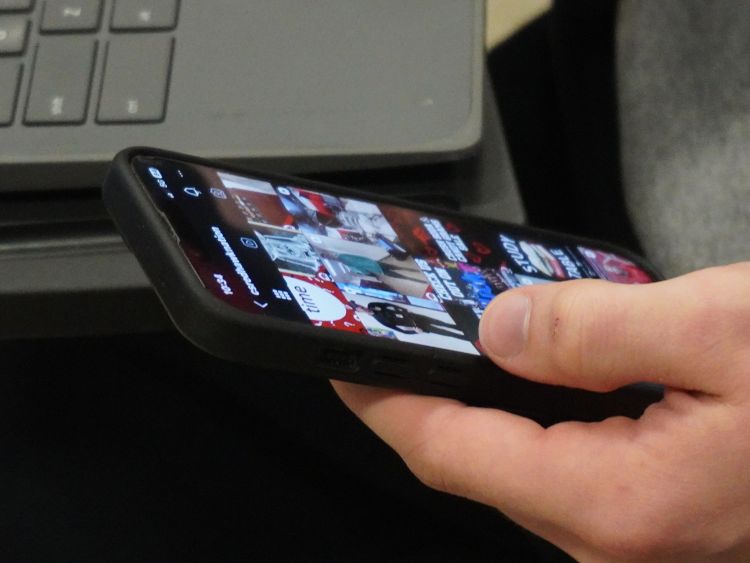
All districts — You’d think that if anyone would take issue with the state restricting smartphone use in Michigan’s K-12 schools, it would be someone like Lauren Banaszak.
The Cedar Springs High School junior spends about nine hours a day on her phone, using it for school, work, scheduling and basic communication. But Lauren isn’t against the new legislation that will prohibit the use of smartphones during instructional time.
The new law was signed in February by Gov. Gretchen Whitmer, and it goes into effect at the start of the 2026-27 school year. It allows for provisions to be made to let students, with teacher permission, use smartphones during emergency situations, for medical reasons or for educational purposes, and it gives districts the final word on how they’ll enforce the policy.
‘I think it’s really helpful to have something that’s just statewide. If you want to do more, you can, but this is the baseline.’
— Rep. Carol Glanville
Lauren said she’s all for it.
“I think the benefit is probably more (student) engagement,” she said of the law, adding that some forms of bullying will probably drop off if students are forced to spend less time on phones and social media apps while at school.
Lauren said she’s fine with the legislation as long as it doesn’t lead to rules that are more restrictive than those Cedar Springs currently has in place. The district, like many others, allows smartphone use before school, after school, at lunch and between classes, but students are usually asked to put their devices away in “phone garages” during class.

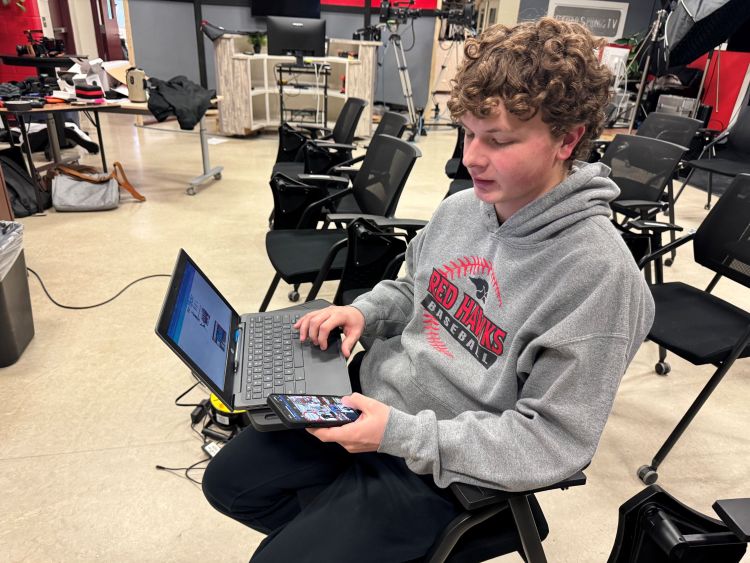
Lauren’s classmate, senior Henry Satterthwaite, falls on the other end of the smartphone-use spectrum. He only spends about two hours a day on his phone — three hours, tops — but his sentiments line up with hers. Neither student sees much of a downside to keeping phones out of the classroom.
“Being on my phone in class time is pretty counterintuitive for me,” Henry said. “If I’m on my phone, for whatever reason, during class, by the time I end up dialing back into class … I’d be completely lost.”
When Lauren and Henry are using their phones in school, it’s usually in one of Justin Harnden’s media classes. Harnden relies heavily on smartphones for classes in video and social media, but he thinks the new legislation is reasonable, and he’s glad that individual districts will be able to determine how strict they want to get with their policies.
“We have to teach kids to be responsible users of it,” Harnden said. “I think the legislation trusts us enough to say, ‘If it’s an instructional reason you can use it, but if you don’t need it, don’t use it. Don’t be dependent on it.’”
Positive Reactions
The opinions shared by Lauren, Henry and Harnden seem to mirror those of the Kent County education community in general — not just students and teachers, but administrators and education advocates as well.
84th Dist. State Rep. Carol Glanville, D-Walker, called the new legislation a “win-win-win” that will benefit students, educators and families.
Glanville noted that most, if not all, districts already have policies to regulate smartphone use, but those policies vary from district to district, or even from building to building. And they can be tricky to enforce.
‘It aligns with our belief that it’s best for kids to focus on the content and not on their phones when instruction is happening. It’s great that we’re all on the same page now.’
— Joel Stoner, Sparta superintendent
“I think it’s really helpful to have something that’s just statewide,” said Glanville, a former teacher. “If you want to do more, you can, but this is the baseline. It takes pressure off of teachers from having to have those battles with the students, or even parents.”
Dan Behm, executive director of Education Advocates of West Michigan, said the law is not going to lead to big changes for most school districts. He likened the legislation to “spiking the football long after the touchdown has been made,” but he said it’s been well received by education leaders. At least, he said, he hasn’t heard much, if any, backlash.
“The law is just sort of catching up with what the field has been doing for a number of years,” Behm said. “I haven’t heard of any districts saying, ‘Boy, this is going to really affect how we do business.’ Instead, what I’m hearing is districts saying it gives (them) more support in rare situations when a student says, ‘You can’t stop me from having my phone.’”
So, what does this all mean for Kent County schools? SNN spoke to a few districts about it.
Keeping the Focus on Learning
The new law won’t result in major changes for Grand Rapids Public Schools, which is the largest district in the region. GRPS has policies in place for the K-5, middle-school and high-school levels. Smartphones and other electronic devices are banned outright for K-5, allowed before and after school only for grades 6-8, and allowed with teacher approval for grades 9-12.
Still, the district thinks the new law will bolster its existing practice, and standardize expectations throughout the state.
“The new state law aligns schools across Michigan with the standards that Grand Rapids Public Schools has already put into place, but we do believe that this added clarity will strengthen compliance here at GRPS,” said Luke Stier, the district’s director of communications.
Over the past few years, Sparta Area Schools has implemented smartphone policies at its middle school and high school. Those policies mostly line up with the new state law, said Superintendent Joel Stoner.
“This new law, it’s going to have minimal impact on our system because we’re already doing it,” Stoner said. “What they’re asking of us we’re already doing, so it’s going to be pretty easy.”
‘I don’t get tempted to check my phone constantly and I don’t get distracted by my peers using their cellphones.’
— Ahana Hari, Forest Hills Northern Middle eighth-grader
Stoner noted, however, that the district will have to develop an elementary-level policy in order to be in compliance with the new law. He said he’s not particularly concerned about that, since the state now has a solid framework to use as reference.
“It’ll be a quick adjustment but nothing too strenuous,” he said.
Overall, Stoner said the district is in favor of the new law.
“It aligns with our belief that it’s best for kids to focus on the content and not on their phones when instruction is happening,” he said. “It’s great that we’re all on the same page now, that local communities don’t have to try to navigate this. … It’s been settled for us.”
The law is also not likely to disrupt things much at Forest Hills Public Schools, which has been enforcing a “bell-to-bell” smartphone ban since 2018. But FHPS Superintendent Ben Kirby thinks it’s smart to have the law in place, noting that the benefits of regulating smartphone use are manifold.
“There is existing and growing research on the negative impact that smartphones cause instructional interruptions, along with 24/7 social comparisons and, in some cases, bullying,” Kirby said. “Having a statewide ban does allow communities that need additional support to move forward with a policy without local ramifications. There is local control during non-instructional times, which will allow districts to recognize the needs that they believe to be important for their communities.”
Like Lauren and Henry over in Cedar Springs, FHPS students are surprisingly supportive of smartphone restrictions. Tia Kobler, Ahana Hari and Kenzie Hasson — all eighth-graders at Forest Hills Eastern Middle School — praised their district’s existing policy.
“I believe the no-cellphone rule has been beneficial for me, as my average screen time is much lower on weekdays compared to weekends,” Tia said. “It has helped me stay more focused during the school day.”
Ahana said the district’s policy has helped her learn to control her phone use and spend more time with her peers rather than relying on her device.
“I don’t get tempted to check my phone constantly and I don’t get distracted by my peers using their cellphones,” she said.
Kenzie said not having her phone has helped her concentrate during the day without distractions.
“It feels good not to spend all day, every day on my phone,” she said.
Reporter Joanne Bailey-Boorsma contributed to this story.
Read more:
• Education advocates grapple with potential closure of DOE
• Student entrepreneurs: making money doing what they love


