


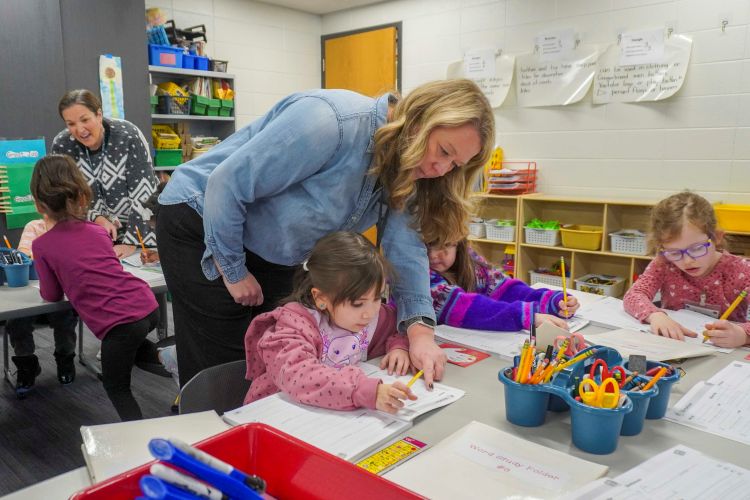
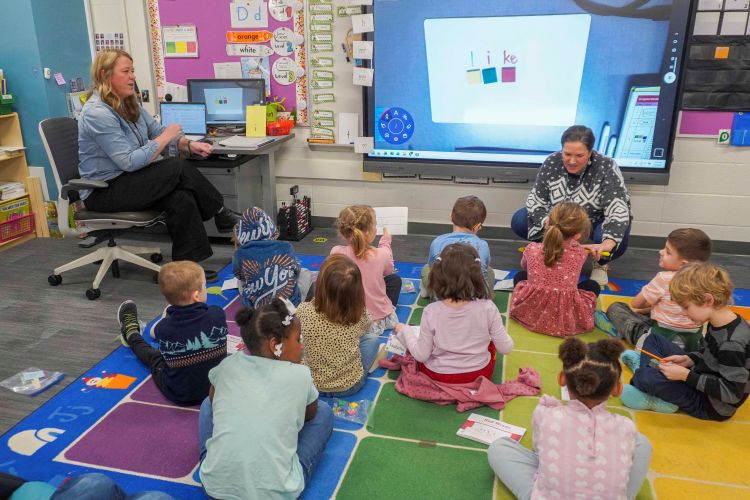
Northview — As kindergartners settled onto their colorful squares on the floor, East Oakview Elementary teacher Angie Hoogenstyn pointed to the word “like” written in multiple colors on the screen.
“Let’s listen for how many sounds we hear in the word ‘like,’” she said.
Pointing to the L, she articulated, “llllll…”
Then to the I: “iiiiii…”
And finally, the KE: “kuh…”
Hoogenstyn had the kindergartners repeat the sounds, then stopped to focus on the middle sound.
“iiiiii…” she said, using the long vowel sound, like “eye.”
“How do we spell that sound?” she asked the students. “What letter is that?”
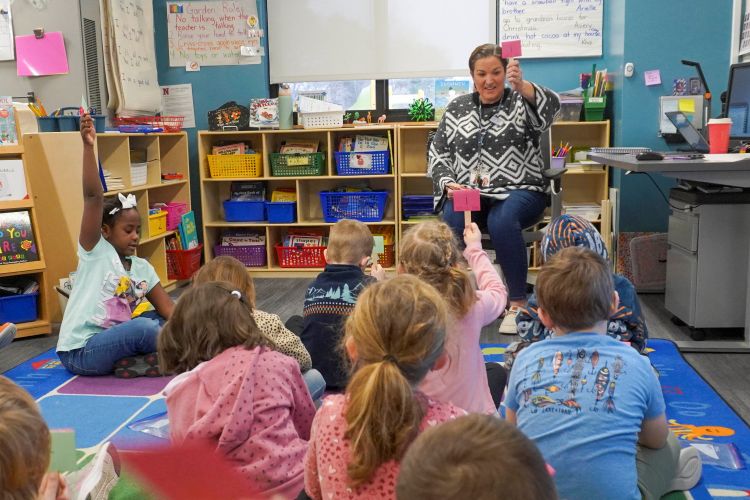
Hoogenstyn then looked up at her colleagues, Dana Calhoun and Robin Murphy, who were standing in the back of the classroom observing the lesson.
“Remind me,” she asked them, switching out of her teacher voice for a second, “do we normally do letters or sounds first?”
Building a Community of Learning
As Northview Public Schools rolls out a new phonics program in its K-5 classrooms, Hoogenstyn, Calhoun and Murphy recently took part in a “learning lab” to see how their colleagues are using these new lessons. All three kindergarten teachers spent one period in Calhoun’s classroom, with Calhoun’s students, teaching separate parts of the day’s phonics lesson.
The goal? To learn from each other, practice different techniques and ask questions regarding their colleagues’ methods.
“When you’re in your classroom with your 25 kids, you kind of do your own thing and you don’t necessarily know what the person next to you is doing,” said Katie Gilbert, a DK-5 instructional coach. “To see what others are doing, to get ideas from them, to be able to ask questions of one another, it all builds this community of learning with our teachers. And it builds their confidence, too.”
Gilbert has been working with elementary teachers to train and coach them on the Orton-Gillingham approach to teaching reading, writing and spelling, which the district purchased using funds from the State School Aid Act. In lower elementary, students start with skills involving letters, sounds and syllables and then build on these skills over time.
‘To see it in action, in real time, with each other’s students, is so valuable.’
— Robin Murphy, East Oakview kindergarten teacher
“It’s really rigorous, and we’re asking kids to do some things that we maybe haven’t done in the past — different routines to use when they sound out words, things like that,” Gilbert said. “And so our teachers are having to learn these different routines, too, and know what works and how to teach them.”
The three East Oakview kindergarten teachers, who have been working in the same building for four years (but all teaching much longer than that) specifically requested the learning lab so that they could all be in one room together as they taught.
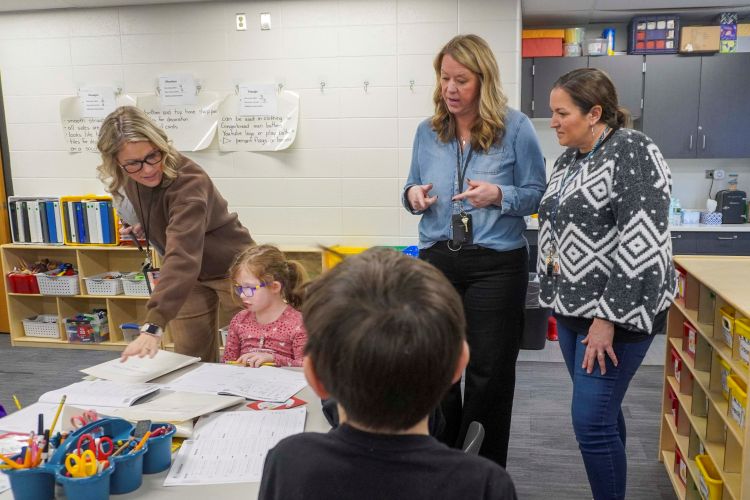
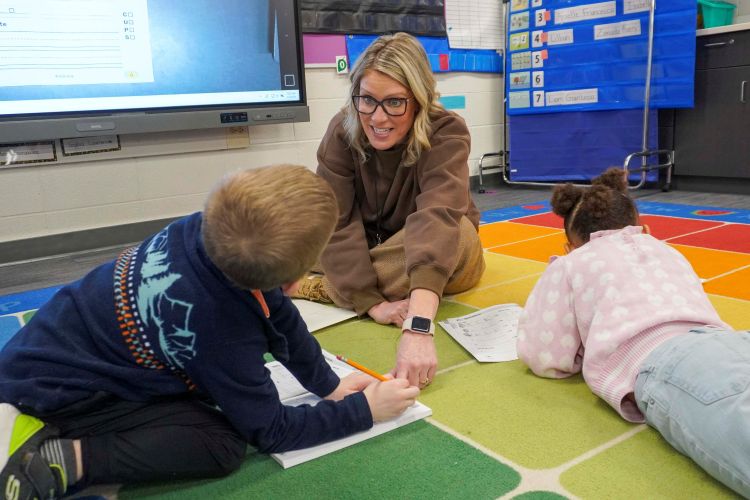
“We never have the opportunity to go watch each other in action,” said Murphy. “To see it in action, in real time, with each other’s students, is so valuable. With a new approach, we have so many questions, and when you’re a lone island trying something new for the first time, that can be tricky. It’s really affirming to do it with your colleagues and also see them do it.”
Common Processes
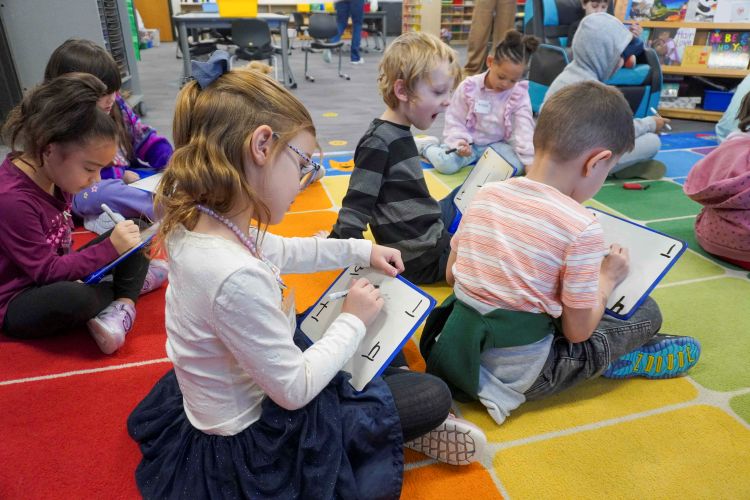
During the lab, the teachers split up instruction for the day’s phonics lesson, which included vowel sounds, dictation, syllables and worksheet exercises. From time to time, the teacher “in charge” would stop to ask questions, or the observing teachers would point out something new.
At one point during her teaching time, Murphy reached for some sticky notes, only to realize that Calhoun didn’t have any on her desk — which led to a quick discussion on why they could be helpful. The three also discussed the benefits of writing on the board versus using slides when working on irregular words.
In a debrief following the class period, Calhoun joked about time constraints: “This really solidified that I’m doing things right, because I’m running out of time and I see everyone else is, too,” she said.
But the three agreed their processes have more in common than not.
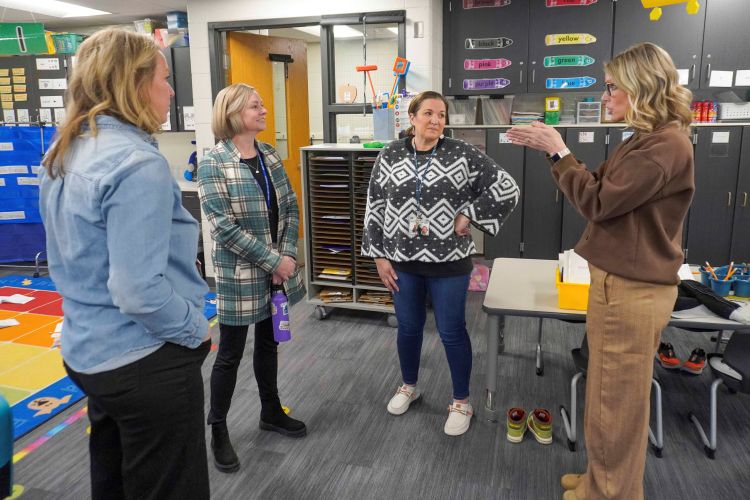
“It feels like a positive experience to see that we’re doing things very similarly,” Hoogenstyn said. “I think some of the biggest differences are how we do things organizationally in our classroom, or our transitions when getting supplies out. But as far as what we’re teaching, I feel that’s very similar and that’s good.”
While kindergartners’ attention spans can wear thin during phonics lessons, Hoogenstyn said these new methods are helping with that.
“The structure of (Orton-Gillingham) kind of lends itself to (paying attention) because it’s hands-on, they’re moving, getting out supplies and using things in different ways,” Hoogenstyn said. “All of that helps them to remember things. But it’s going at a different pace, so we just have to work on the flow and efficiency.”
As recess began and Murphy started to head back to her own classroom, one of Calhoun’s students came up to give Murphy a hug.
“It was fun to come learn with you and do phonics with you!” Murphy told her. “Teachers get to learn at school sometimes, too — that’s pretty fun.”
Read more from Northview:
• Mileage Club promotes fitness & more
• Learning garden’s growth fueled by veggies, students, ‘lots of love’


