


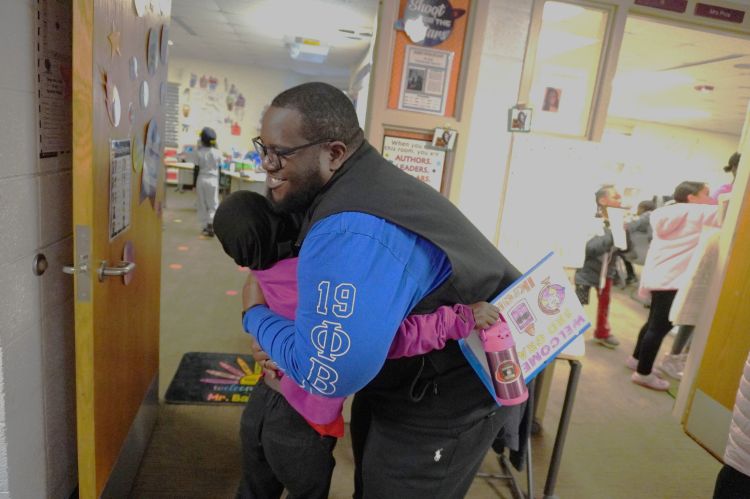
Kentwood — Whether it’s a sleepy Monday, midweek Wednesday or a lively Friday morning, one thing guaranteed for students at Challenger and Bowen elementary schools: they will arrive at their classroom door to a warm welcome from a smiling teacher.
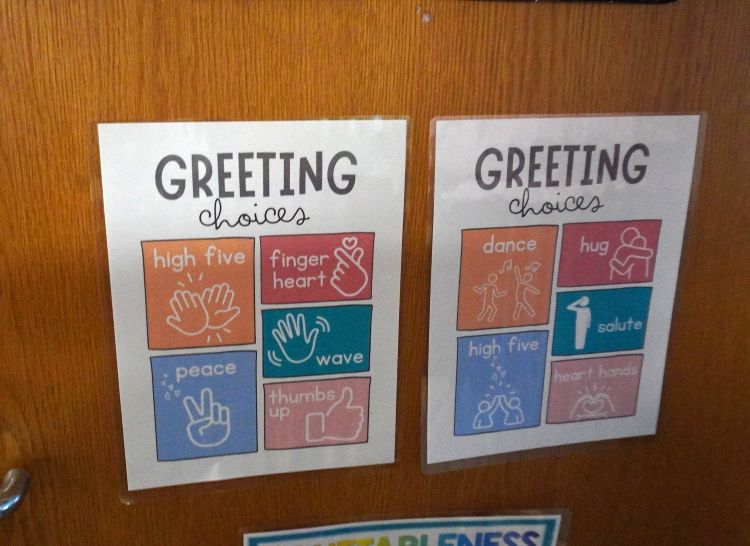
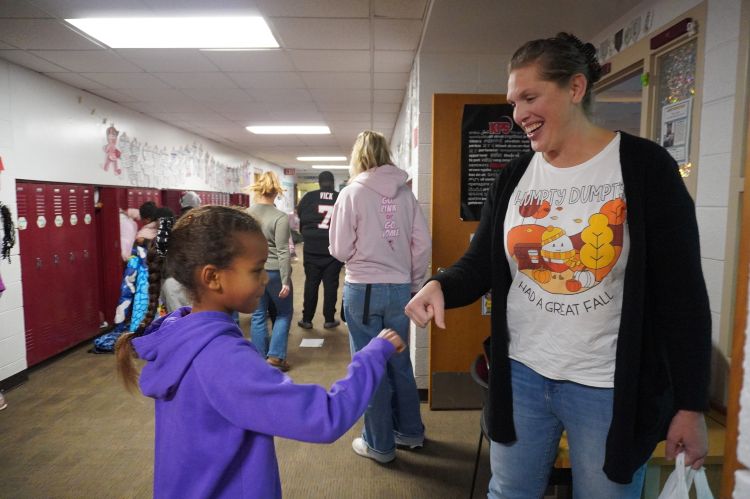
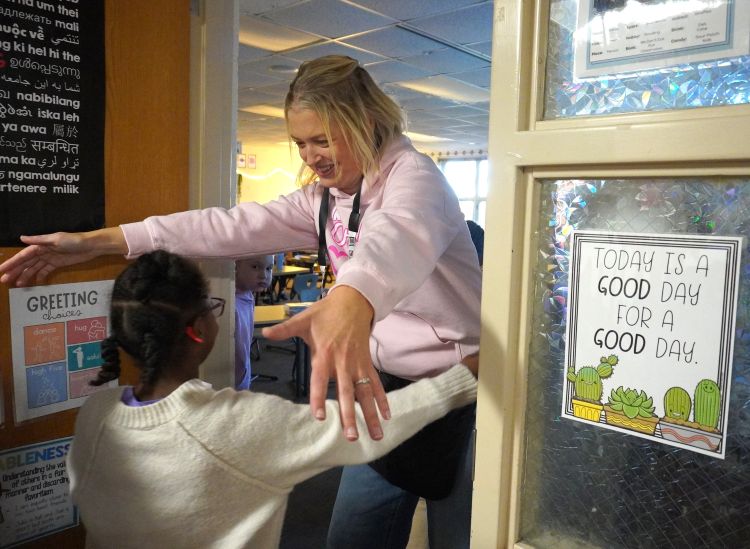
What’s up to each student, however, is how they are greeted. Before entering class, they say or point to a sign indicating if they want a high five, a peace sign, a wave, a dance, a thumbs up, a hug, a salute or heart hands. Some students choose the same greeting every morning, and others mix it up a bit. The teachers oblige.
Challenger third-grader Javen Suggs always picks a salute, raising his right hand to his forehead while his teacher, Heather Cobbs, does the same.
“I want to be a leader,” he said about his greeting of choice.
Third-grader Naziah LaBlanc-Morrow asks for three hugs.
“I love getting hugs and to give hugs too. They warm me up,” she said.
Morning greetings jumpstart the day in a positive way, teachers say, and it’s one of the first strategies Challenger and Bowen staff have implemented through a partnership with Project ReACT, a professional development intervention to increase racial equity in school discipline.
Challenger and Bowen elementary schools are partnering with the University of Oregon and the Multi-Tiered System of Supports team from the State of Michigan on the one-year project. Discovery Elementary took part last school year, and KPS plans for each of its 11 elementary schools to participate. Representatives from the College of Education at University of Oregon and from the MTSS Technical Assistance Center work with the staff throughout the school year, including during monthly meetings.
‘This has allowed me to realize the importance of education and how it can be a disruptor to negative social influences.’
— Challenger Elementary Principal Dwight Quinn
While the work promotes connection and a positive school climate, said Challenger Principal Dwight Quinn, a specific goal is to address a disparity present in student data on office discipline referrals. During the 2024-25 school year, Black students were 1.4 times more likely to receive at least one office discipline referral as compared to all other students at Challenger.
Bowen’s data showed a disparity as well, with Black students 1.9 times more likely to receive a discipline referral, said Principal Mary Campione.
Project ReACT uses schools’ Positive Behavioral Interventions and Support frameworks to determine if there are student groups PBIS is not working for. Then staff members implement strategies to help those students benefit. PBIS sets common goals and expectations school-wide and rewards positive behavior.
Quinn said the team has selected four strategies hoped to offset the disparity at Challenger by focusing on the individual needs of every student.
“This work is really just identifying our students for their unique selves, and really honing in on being intentional about celebrating them and uplifting them. Part of the work we are doing in the district through the strategic plan is focusing on the whole child. This is one way we will address and connect with the whole child as well,” Quinn said.
Campione echoed that sentiment.
“Our goal is to build deeper relationships with our students while specifically recognizing how to build those relationships with our African American students so they are receiving more positive praises. Ultimately, we want the outcome to be greater equity in our district data.”
Honoring Individuals
Strategies focus on connecting with students in ways that respect their preferences and speak to their needs beyond academics, Quinn said. They get to the heart of who the student is in relation to their background, personality and culture.
Along with how they are greeted, Challenger students are sharing how they prefer to receive praise. Teachers survey students individually: Do they like the spotlight? Do they prefer quiet one-on-one praise? Similar to love languages, it gets to the heart of culture and personality, Quinn said.
Staff at both schools are also reaching out beyond the school walls by sending postcards home to share about students’ good quality, accomplishment or deed with parents and caregivers. Especially for families that typically only get calls home from school for negative reasons, it can be a game changer, Quinn said.
“What we find is, often parents get too used to the school contacting them only when there is a negative situation,” he said. There are always great things that every kid is contributing to school. We want to share those things with those families.”
School vs. Home Expectations
Another strategy gets students thinking about behavior expectations in every aspect of their lives. Students created personal matrices at the beginning of the school year in complement with their PBIS systems. At Challenger, the system, SCORE stands for safe, in control, organized, respectful and giving their best effort.
PBIS sets common school-wide expectations for every location throughout the school, and the personal matrix zooms in on how those expectations apply to each student — extending to home and in the community.
“That allows students and teachers to have conversations with each other about where differences exist and how that might contribute to misconceptions at school,” Quinn said. “That gives the teachers an insight on the connections or the home lives of some of our students and how to bridge any gaps that we might be missing at school.”
The matrix strategy has proven to be eye-opening at Bowen with their Falcon Feathers system, Campione said. The three behavior expectations there are “be respectful, be responsible and be safe.”
“It was very easy for students to identify what that looks like at school, but then it became more challenging to identify what that means at home and with their friends. It opened our eyes as adults, and it also gave us an opportunity to have conversations with our students that they are not having a home.”
Minutes after greeting all her students in their favorite way, Challenger third-grade teacher Cobb said she loves seeing the positive reactions every day from students during the greeting.
“It’s been a great opportunity for us to have more intentional conversations about what we are seeing in our school, what our numbers are saying and how we want to improve, how we interact with our kids and how we support them to be successful,” she said.
Quinn said the work is personally meaningful for him, as a Black man who grew up with few positive role models.
“I come from a background that may be considered disadvantaged (so) I believe this allows me to connect well with students that have similar experiences,” he said. “This has allowed me to realize the importance of education and how it can be a disruptor to negative social influences. At Challenger, we believe that students can achieve regardless of socioeconomic status.”
Read more from Kentwood:
• KDL partners with elementary school for Family Literacy Night
• Cookie decorating? LEGOs? Chess? There’s a club for you!


