


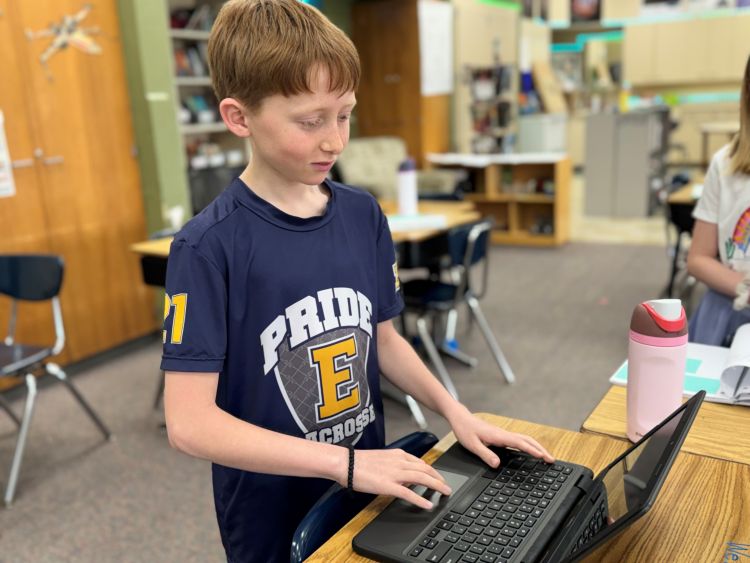
East Grand Rapids — Asher Hax has a decision to make: either save his friends and remain trapped in a digital world forever, or return to the real world and let his friends fend for themselves against the villainous Arcady.
This is the picture fifth-grader Wes Haddad paints of the culminating moments of a story he wrote during a fantasy writing unit in Tim Saunders’ class at Wealthy Elementary.
Asher Hax is the hero of Wes’ story about a group of friends transported by portal into a kind of virtual-reality realm and given 48 hours to escape.
The choice Asher makes might surprise you, as it doesn’t fit into the typical hero’s journey storyline structure — though it might make for a very fitting start to a larger story that does.
“He chooses to go home,” Wes said. “I chose that because I thought it would set up a good story for the next one.”
Wes said he’s hoping to continue the story and give his protagonist a chance to revisit the digital realm, change the past, and defeat the evil Arcady, possibly finding a way to rescue his friends in the process.
“Asher’s going to go back and fix the past,” Wes said. “And maybe he could bring back his friends.”
Worldbuilding
Saunders’ fantasy writing unit tasked students with creating their own worlds, characters, mythologies and more, and challenged them to tell a contained story that could also serve as the jumping-off point for a continued universe.
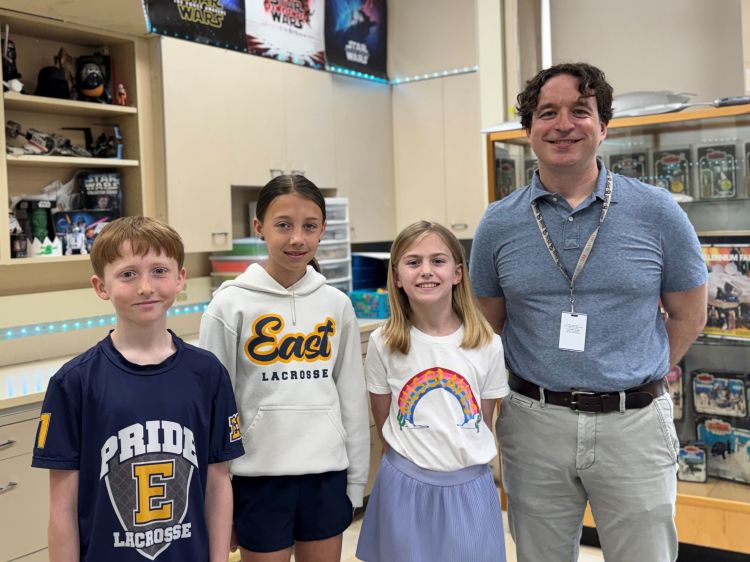
Saunders — whose love for sci-fi and fantasy is evident by the collection of “Star Wars” posters on his classroom walls — has been teaching fantasy units at Wealthy for a few years. He helped pilot the curriculum guide he now follows, “Teaching Fantasy Writing K-6” by Carl Anderson, and some of his previous students’ work can even be found in Anderson’s text.
“It’s a way for them to really stretch and flex their creativity in ways that they haven’t had a lot of opportunities to do yet in writing,” Saunders said of the use of fantasy in elementary-level writing instruction. “And I think that it’s fun. Like, it’s really fun to be creative. It’s fun to have your own world, to be inspired by fantasy elements and sci-fi elements.”
The unit involved a survey of different sub-genres of sci-fi and fantasy, so students could get an idea of what was possible and identify sources of inspiration.
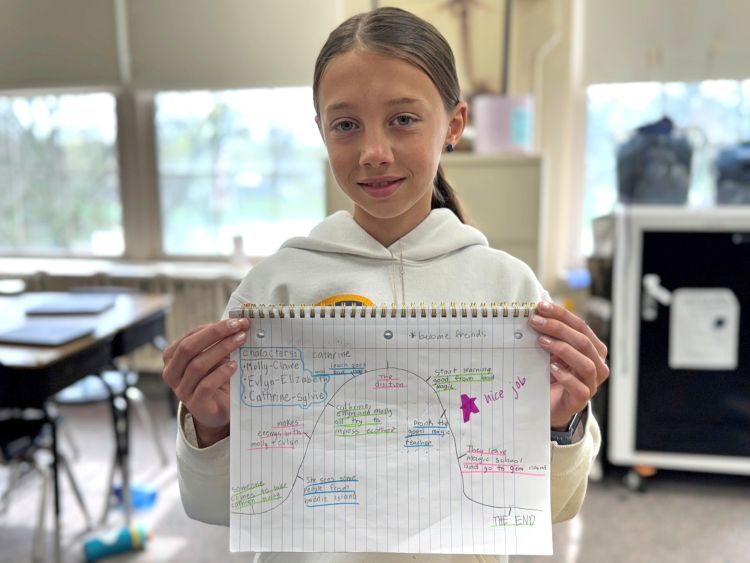
Wes’ story was heavily influenced by the “Tron” movies, while his classmates Clarabel Duquette and Sylvie Baldwin went for more classic, good-versus-evil fantasy stories, inspired by “Harry Potter” and “The Lord of the Rings.”
“In my world, they’re basically elves,” Clarabell said, explaining that the elves are divided into different tribes based on different elements.
Her main character’s parents are “dark elves, known for their bad deeds,” Clarabell said, and the character has to choose between following in her parents’ footsteps or joining the elemental tribe of her friends.
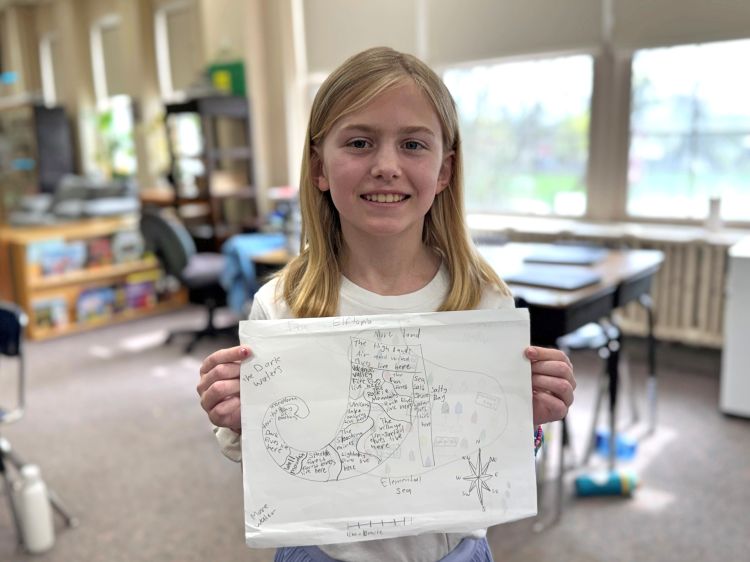
Sylvie’s story, set in a world of islands and focused on the goings-on of a school for people with magic powers, has similar elements.
“My character’s parents are also evil,” Sylvie said. “My character has to choose if she wants to be like her parents or try to be good. She chooses to be good and she thinks it’s a good choice.”
Sparking Creativity
The three fifth-graders said they loved every minute of the assignment, from the worldbuilding and character development to actually putting pen to paper and bringing to life the characters they imagined.
“It was a really great unit,” said Wes. “It sparked creativity, I think, in a lot of my classmates and (me).”
Clarabel’s favorite part of the unit was the planning stage, when she first started developing her own fictional world.
“We had a long time to let our creativity just flow onto pieces of paper,” Clarabel said. “We all made these worlds. We revise and edit until we come up with this world that we loved and would want to be a part of.”
Sylvie appreciated the opportunity to let her imagination run wild.
“I like that we got to be creative, and you got to really make it your own,” she said.
‘It’s a way for them to really stretch and flex their creativity in ways that they haven’t had a lot of opportunities to do yet in writing.’
— teacher Tim Saunders
Saunders said his students really rose to the occasion, embracing the assignment with enthusiasm and excitement.
He also applauded their restraint. Sylvie, Clarabel and Wes all had massive worlds in mind, he said, but they were able to find a way to tell relatively simple, five-page stories that captured the essence of those worlds.
“All three of them had really rich ideas and really complex moments for their characters, so they were great to work with because they were able to embrace telling a small sliver of a much larger piece, but also telling a complete story within there,” he said.
With the help of a grant from the East Grand Rapids Schools Foundation, Saunders was able to attend the National Council of Teachers of English conference in November, and as part of his presentation to NCTE, he included some of the students’ work.
The teacher said fantasy writing can help students process and understand the world around them. He pointed to a quote from one of his favorite musicians, Jeff Tweedy, frontman of the band Wilco: “Creativity eats darkness.”
“The world can be a real challenging place,” Saunders said. “I think that giving students the opportunity to be really creative and have a chance to bring something new into the world … is great. And I hope that more writing teachers take the time to have their kids create their own worlds and tell their own stories.”
Read more from East Grand Rapids:
• Teacher strives to empower through art
• He plans to ‘walk the line’ in new AP role


