



All districts — The fiscal year 2027 state education budget, signed July 21 by Gov. Gretchen Whitmer, includes two significant changes for school districts: a weighted funding formula and a new approach to calculating enrollment for state aid.
These changes, in addition to new investments in literacy and continued funding of other educational programs, will make a big difference in meeting the needs of all students, say local education leaders.
“It’s a hallmark day,” Kentwood Public Schools Superintendent Kevin Polston said. “For the first time in three decades, the state has changed how we fund education.”
The $502 million budget includes legislation that moves Michigan to a weighted per-pupil funding formula, a change for which local educators, including Polston and Dan Behm, executive director of Education Advocates of West Michigan, have advocated.
The formula adds extra funds for students with greater educational needs. Students learning English or who are economically disadvantaged will be funded at a 20% increase over base funding.
Due to the straightforward formula, districts will no longer receive their at-risk funds through Section 31a dollars, which came with restrictions for use.
‘We’re going to be able to have this true team-teaching approach. There’s no way that we could have done that if 31a funds were still as restrictive as they were.’
— Kent City Superintendent Bill Crane
The budget also includes a 2.5% increase in base per-pupil funding — an additional $250 per student — for a total of $10,300 per pupil.

Behm said the weighted funding gives districts greater flexibility to use support staff where they are needed most, rather than limiting them to serve only students who qualify under specific funding sources, as was done in the past. For example, a social worker can now be assigned to a school building and provide services to any student who needs additional support.
Across the county, school leaders are lauding the change and additional flexibility to serve students.
“It really acknowledges that student needs are unique,” Polston said.
Grand Rapids Public Schools Superintendent Leadriane Roby said the new formula provides her district with “broader discretion in deciding how to allocate funds.”
“The fact that the legislature put this formula in statute reinforces the state’s commitment to this approach long term,” she said.
Formula Leads to ‘True Team-Teaching’
In Kent City Community Schools, that new flexibility thanks to the weighted formula is allowing the district to make a direct instructional change — restructuring how sixth grade operates, said Superintendent Bill Crane. The plan is to move sixth grade to a “team approach” involving four teachers, two who are newly hired, with the goal of helping students with the often difficult transition to middle school.

“(The teachers) will regularly meet as a grade-level team in order to have conversations around which students are struggling more, which ones might need help with math specifically, or whatever those needs might be,” Crane said.
During elective class time, the math teacher and English teacher will work with students who have been identified as needing extra supports.
“We’re going to be able to have this true team-teaching approach. There’s no way that we could have done that if 31a funds were still as restrictive as they were,” he said.
“This is brand new to how we’re going to approach things for sixth grade. I’ve been here 16 years and we’ve never done anything like this, and now we have the flexibility with the new funding to pull that off and support our students in a way they need.”
The structure will allow the extra focus students often need as they begin middle school, he said.
“That all plays into the overall goal of being college and career ready, and we want to set them up well for the long haul,” Crane said. “This just gives us a lot of flexibility to maybe take care of different things for our at-risk population that we weren’t able to do in the past.”
Averaging Student Counts
Also transformative in the budget, Behm said, is the option for districts to use a three-year average student count to determine enrollment and calculate state aid. That’s a change from an earlier formula that used 90% of the school year’s fall student count and 10% of the previous school year’s spring student count to calculate the year’s enrollment number.

Now, Behm said, school officials will be able to choose the option that provides the most state aid funding for their district — either the current year’s student enrollment or the three-year average. For example, a district that lost students in recent years but sees enrollment rebound this year could use its current enrollment count instead of the three-year average.
For the past several years, school districts have faced the challenge of building budgets amid ongoing uncertainty fueled in part by declining enrollment. Behm said national trends, including lower birth rates and rising housing costs, have played a role.
The new approach to student counts will help districts plan for those realities in a responsible and methodical way, he said.
“Previously, districts were more reacting to those realities in the best way they could, which oftentimes for staff members and families and students felt like a last-minute surprise,” Behm said.
In Kentwood, Polston said it will be very helpful to know two of their three enrollment data points for per-pupil funding allocation well ahead of the due date for school budgets.

Roby agreed: “The three-year average student count provides more stable and predictable funding, allowing us to plan and develop annual budgets with greater confidence,” she said.
In Kent City, Kent County’s smallest district, Crane said enrollment swings can hit especially hard, funding-wise.
“A 10-student swing for a district our size is pretty big,” the superintendent said. “We’ve had years when we were up 20 and years when we were down 20, and so having that three-year average will definitely help us in terms of planning effectively and maybe not feeling it as bad if there’s a lower year.”
All In for Literacy Training
The new state budget also includes a major investment in student literacy, with $502 million allocated toward literacy curriculum, training for teachers, before- and after-school programs, literacy coaches and tutoring.
This funding, according to information from the state, includes $123.1 million to train teachers in the science of reading instruction, including:
- $75 million for every reading teacher to complete Language Essentials for Teachers of Reading and Spelling (LETRS), which trains educators in the “science of reading,” including strategies like phonics.
- $10.5 million to expand access to literacy coaches.
- $7.6 million to support the Literacy Essentials phonics program, as well as comprehensive professional learning about the science of reading for educators at all grade levels.
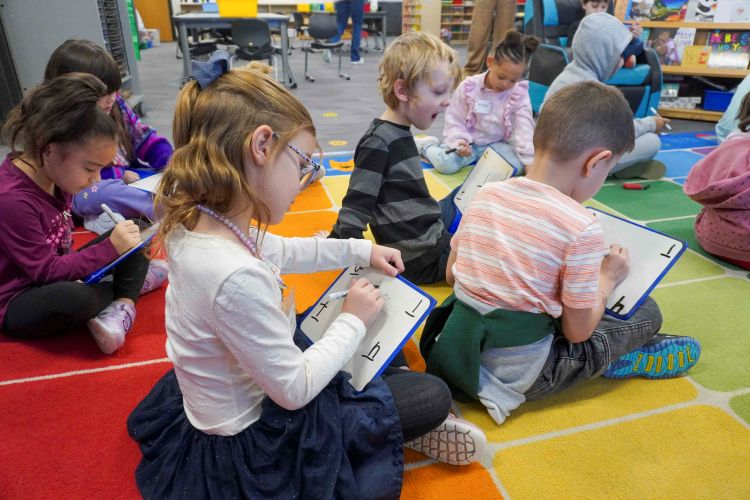
The monetary investment backs up new legislation that requires elementary teachers to complete intensive training in the science of reading, including phonics. Nearly 7,200 educators statewide have already completed LETRS training and more than 5,700 are enrolled now, according to communications from the state.
About three dozen KPS teachers have already completed LETRS training, and Polston said more conversations will occur on how to accomplish the training, which is a significant time investment for teachers.
In GRPS, more than 200 teachers have completed or are in the process of completing LETRS training, Roby said. The district is taking part this school year in a training offered through the Michigan Department of Education to train more educators.
“Science of reading instruction is making a measurable difference in Grand Rapids,” she said. “Schools with LETRS-trained teachers are seeing reading scores improve, and we know this approach works.”
At a glance: Michigan’s 2027 state education budget
The 2027 state education budget, signed by Gov. Gretchen Whitmer in July, invests:
- $96.1 million to continue free pre-K for all through the Great Start Readiness Program program, and $30 million to expand and support the early educator workforce
- $200 million to continue free school meals for all
- $150 million to continue bonuses and supports for teachers and educators across Michigan
- $107 million to support the MI Future Educator Fellowship Program, teacher stipends, and Grow Your Own mentoring programs — all aimed to help attract, recruit and retain high-quality educators
- $321 million to support student wellness through mental health and safety grants
- $125 million to reimburse districts with exorbitant transportation costs
- $123 million to continue expanded support for special education students
- $40 million to reimburse eligible districts for dual enrollment costs
Source: Gov. Whitmer signs education budget to help every kid read, eat and succeed
Reporters Joanne Bailey-Boorsma and Beth Heinen Bell contributed to this story.
Read more from our districts:
• Schools see success in statewide push for phonics-based approach to reading
• Coaches offer ongoing support for preschool teachers


