


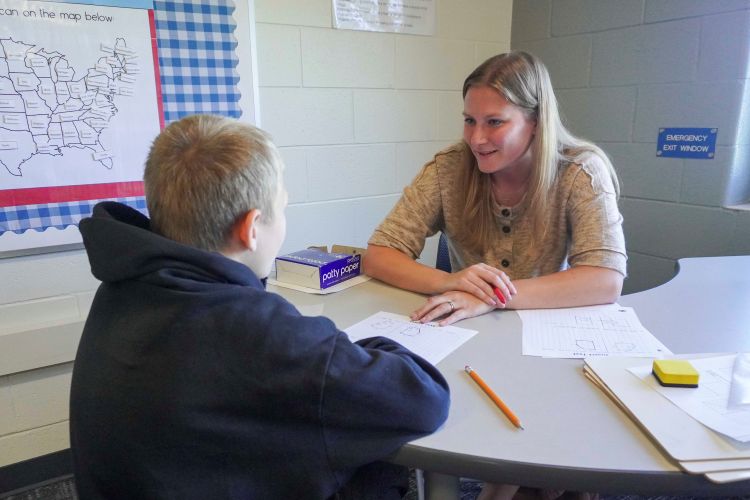
Northview — “I’m there to support everybody,” Ally Mabry says of her role as an eighth-grade special education teacher at Crossroads Middle School.
A key part of her daily work is to support eighth-graders who have an IEP (individualized education program). In her academic support classroom, she meets with students to work on pre-teaching or reteaching core content including math, science, history and English language arts.
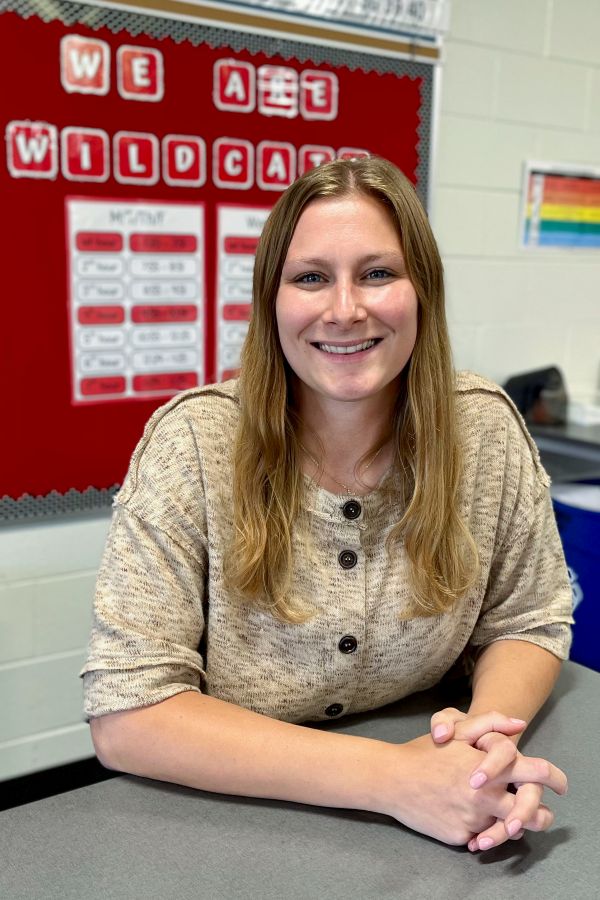
Crossroads also has a co-teaching model, meaning Mabry is a regular presence in all eighth-grade math and ELA classes. She’s there to help not only “my kids,” as she calls them, but anyone who may need a little extra guidance.
“While the lead (teacher) is teaching, I’ll walk around and if I notice that a kid seems lost, I’ll sit next to them and guide them through the work,” she said. “Or I might pull a group to the side and work with them on practice problems.
“I’m there to support my kids with IEPs, but I’m reaching all the kids. I want all of them to view me as a teacher who can help them, and not just this person that only talks to a handful of kids.”
For Mabry, who is in her fifth year of teaching, the job is both rewarding and personal. Read on to learn more about Mabry’s work and her desire to “do something that matters.”
Why do you teach? Mabry’s “why” is deeply personal, rooted in family.
“I wanted to be a teacher because of my grandpa. He was a teacher and assistant principal in Kentwood Public Schools. He died when I was 13, and people came from literally all over the country to his funeral, talking about how much of an impact he made on them.”

Mabry remembers one former student who drove all the way from Minnesota to share with their family how her grandpa taught him to read when the student was in high school.
“Hearing stories like that really impacted me. I knew then, and I think I’ve always known, that I wanted to have a career where I could work with people on something that mattered and make that kind of impact.”
She chose to root herself in special education because of her brother, who is on the autism spectrum.
“I saw the impact that his teachers had on him … those teachers that understood him and saw him, they really worked hard to help him find success in school.
“I knew that I wanted to be that (advocate) for somebody — to be a voice for them if they couldn’t advocate for themselves, but also teach them how to take the steps to speak for themselves. That was really important to me.”
What is your biggest motivator that keeps you excited about teaching? “Seeing when things click for kids, especially because a lot of the kids I work with have disabilities in a certain area or have difficulty with school in general. Seeing that moment where I’m working with them and then they’re like, ‘Oh my gosh, I get it,’ is awesome.”
What’s the best thing about your position as a special education teacher? “I service such a small group of kids that I really get to know them so incredibly well. I know what their interests are, what they don’t like and the best way that they learn. They talk to me about what’s going on at home. Especially in the resource room, where there’s so few kids around them, they feel more comfortable to be open, and we really get to develop these strong connections.”
What is one of your biggest challenges? “I call it all the ‘extra stuff’ you have to do. Being a special ed teacher, there’s all the extra paperwork and extra meetings. Being a newer teacher, I’m learning how to not take it all home with me. I am victim to that — especially my first couple years — but I need to learn all the material within the core classes, I need to be able to write the IEPs, I need to document their goals and I need to document their accommodations. So I’m learning where I can find the time throughout the day and not put it on as a burden to myself to take home, because it’s important for me to have that home-work balance.
“It’s gotten easier now — I feel like I’ve gotten into the swing of things better. It takes me less time to do stuff now that I’ve gotten familiar. But I had to learn that not everything is as big of a deal as I make it out to be.”

Mabry also tries to model this for her students, teaching them how to prioritize what’s important through weekly check-ins and staying on top of homework assignments.
What’s the most amazing or interesting thing about your students? “They’re all so different, and I think that’s what makes them so awesome. I get to create all these different activities to do that are based off of how they learn best, and that’s a really cool thing I get to do. … I love being able to converse with them, and some of them are a completely different person in the resource setting because they feel more comfortable to talk.”
What would you say to someone who is considering teaching as a profession? “I would ask them their ‘why,’ and make sure that they’re going into it for the right reasons. Make sure that they understand the commitment that it takes and that they are ready to be creative.
“People don’t often think about the creativity — they just think it’s teaching the lessons. But you get to be creative in how you teach. You have to think introspectively: If you were learning the content, how would you want to learn it? What would make it interesting to learn? You don’t want lectures all hour, and you want to take into account all the different learning styles. What can you do to make sure every kid is included in how they learn best? That’s creativity.”
Mabry also highlighted the importance of not just student teaching, but observation in preparation for a teaching career. During undergrad at Aquinas College, she sat in on both special education and general education classrooms in rural, urban and parochial schools to better understand the similarities and differences teachers may encounter. She also student-taught at her high school alma mater, Grandville High School.
‘I’m there to support my kids with IEPs, but I’m reaching all the kids. I want all of them to view me as a teacher who can help them.’
— Ally Mabry, special education teacher
“I think it’s really important that before you become a teacher, that you shadow them and do what you can so that you truly know what it’s like to go into the profession. And talk with parents and other teachers and even students. Because the amount of people leaving the profession after a couple of years is so extreme, and I think it’s because they don’t truly understand what goes into it.
“Obviously, once you get into the field, there’s still going to be things that surprise you, or like, ‘I didn’t realize that was going to be part of the job.’ There’s so much more that you won’t know until you get in it. But for me, it’s been an absolute joy and privilege. … (Northview) is such a special and supportive place; everybody wants each other to succeed. I’ve enjoyed every minute.”
Read more from Northview:
• Opening doors: partnership brings MEERA labs to area middle schools
• Learning to love language and cultures through song


