


Editor’s note: Ariah and Kristie asked that SNN refer to them by their first names. Both responded to questions via email.
Kent ISD — Ariah studies on her tablet, using Khan Academy as she sits on a narrow bunk bed in a compact, utilitarian room, the only other fixtures a steel toilet and wall-mounted table and chairs.
It is her goal to earn her GED in hopes of finding a job after she leaves the Kent County Correctional Facility.
“What’s a better time (to earn a GED) than doing time?” Ariah said.
“Working on this gives me hope. It makes me feel worthy, and class is something to look forward to.”
Ariah is enrolled in a GED program made possible through a partnership between the Kent County Correctional Facility and Kent ISD Adult Education.
In Michigan, incarcerated individuals who do not have a high school diploma or GED are required to participate in educational programs with the goal of earning a GED certificate. Since 2021, Kent ISD Adult Education has provided the programming for the Kent County Correctional Facility, at 703 Ball Ave NE in Grand Rapids.
In those five years, about 435 people have participated, with 90 percent of them residing within the Kent ISD area, said Linda Clayton, Kent ISD Adult Education program coordinator. About 87 have enrolled in the program this year.
About 26 students — four in the 2025-26 school year — have completed the program with GEDs in hand.
The Kent County Correctional Facility has about 20 programs that support incarcerated individuals and prepare them for reentry into the community through education, job readiness and connections to resources.
“We appreciate the partnership and the opportunity to help incarcerated individuals return to society as productive members,” said Sgt. Iyana Goodson, who oversees the facility’s programs. “The (Kent ISD) instructors are a great addition to our programming. Participation remains steady even as the jail population fluctuates, and we continue to receive requests from inmates who want to enroll in the GED program.”
Structured Classroom Learning
The program runs like a regular classroom, where instructors help students at various academic levels work through GED subject areas. Students are required to attend the classes.
Ariah participates in in-person instruction twice a week for about an hour each session. Instructors rotate, serving about 25 students who live in nine self-contained housing units designed for specific groups of inmates.
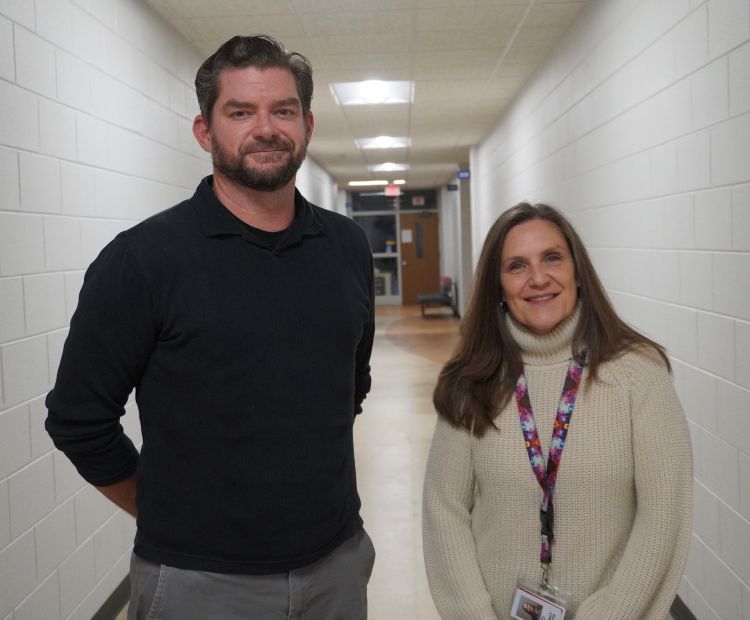
Each student has the chance to work with each instructor at least once a week, said Marty Marquardt, who with Dana Fowle are instructors. Some respond better to a particular instructor or simply need a change of pace.
“There’s not much difference in the person that we have in (the jail) as the person we have in our (general) adult education programs,” Marquardt said. “It’s the delivery method that is, which is more on us then it is on them.”
‘We’re trying to remove as many barriers as we can in a situation that is full of barriers.’
— instructor Dana Fowle
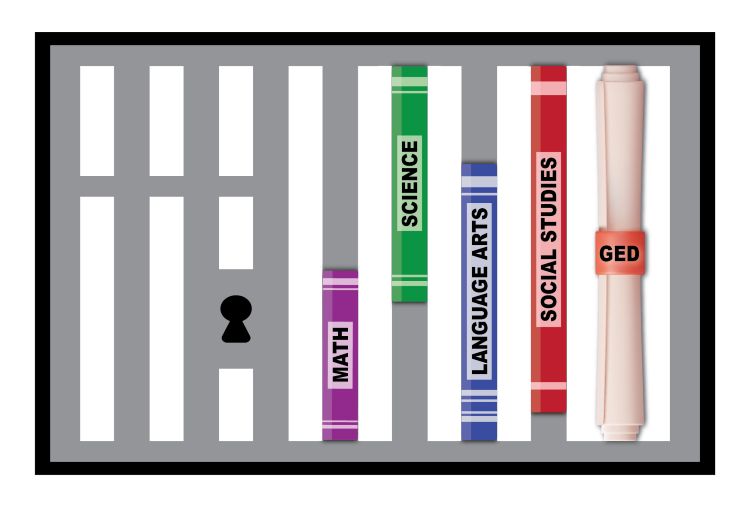
Instruction centers on four subject areas, science, math, language arts and social studies, which students are tested on to receive a GED. Students must demonstrate a high school-level knowledge in each area to pass a subject. Those who pass all four earn a GED diploma, the equivalent of a high school diploma.
After 40 hours of instruction, students are expected to take a test in one subject. About 50% take at least one while in jail, he said.
In the locked-down prison environment, participants are prohibited from having metal school supplies such as spiral notebooks, paperclips and staples. Instead, they use loose-leaf paper and golf pencils. Computers are only allowed for practice tests and the GED, which limits contact with the outside world.
Overcoming Barriers, Building Confidence
Fowle sees the irony in the strict environment.
“It’s interesting that we’re trying to remove as many barriers as we can in a situation that is full of barriers,” she said.
The amount of classroom instruction is significantly less than the 10 hours a week students in a typical adult education program receive and students are also responsible for studying independently using “very thick” GED books, Fowle said.
Ariah said the independent study has helped her build confidence. She figured out a grid-based multiplication technique, the lattice method, on her own.
“I’m proud that I could do it,” she said.
Many students have goals of finding better jobs or furthering their education even more. Kristie, a student in the program, hopes to earn her GED and go to college for sonography.
“I want to do this to prove everyone wrong — the people who said I couldn’t do it. It will also make me feel better about being me,” she said.
It’s successes along the way that help students press onward, like when Ariah figured out the math method or when Kristie passed her science test on the first try, Marquardt said.
Those milestones help change mindsets for students who have been told they are “too dumb” for math or were always placed in lower-level groups. They see that they are capable of learning at a high school level, Marquardt said.
Navigating the Transitions
There’s also anonymity to the program. Instructors are given each student’s name, room, pod number and not much else. A key piece of information the instructors do track down is an inmate’s release date which helps with program planning, Fowle said.
Serving the prison population comes with unique challenges and circumstances, Marquardt explained. Inmate’s release dates can change, and factors like lawyer meetings, jail jobs and participation in other programs can affect progress.
Sometimes inmates are relocated. Marquardt recently had a student close to completion who was moved to a different area that the program does not serve as the inmate prepares to be released. Currently, there are about six inmates needing to complete one test to get their GED.
‘I want to do this to prove everyone wrong — the people who said I couldn’t do it. It will also make me feel better about being me.’
— Kristie, GED program participant
When students are released before earning their GED, they are encouraged to participate in the Kent ISD Adult Education program. Marquardt said they try to make the transition as easy as possible, but other things such as housing, a job, transportation or getting sober often take priority.
It is hard to determine the impact educational programs such as the one offered by the Kent ISD Adult Education has on recidivism, Goodson said. The National Bureau of Economic Research has studied a similar Flint program and found such programs “can reduce post-release recidivism and potentially mitigate the kinds of incarceration cycles that have long stymied criminal justice policymaking.”
“It is beneficial because, even though we have a smaller number of graduates or people who pass tests, it’s still starting that whole process for them of doing something different with their lives,” Fowle said.
Ariah said the instructors have helped her be more accountable in completing the program.
“(It represents) commitment, actually sticking to something and getting it done,” she said.
Read more from Kent ISD:
• Event addresses youth homelessness, on the rise in Kent County
• ‘For me, education was not a luxury, it was a lifeline’


