


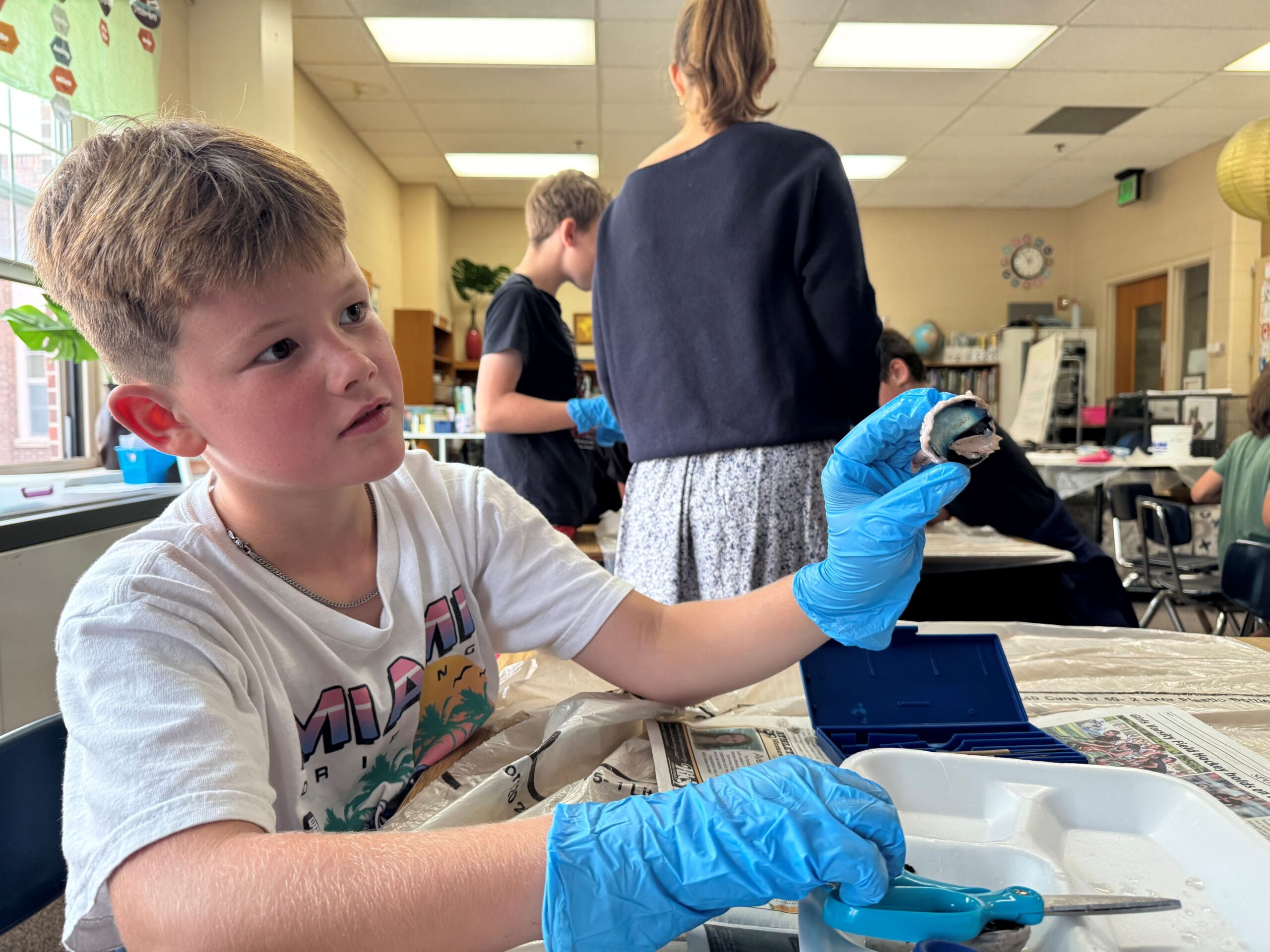
East Grand Rapids — Retinas, optic nerves, pupils, lenses — students at Wealthy Elementary can now identify it all, thanks to a recent lesson that allowed them to explore the components of the eye.
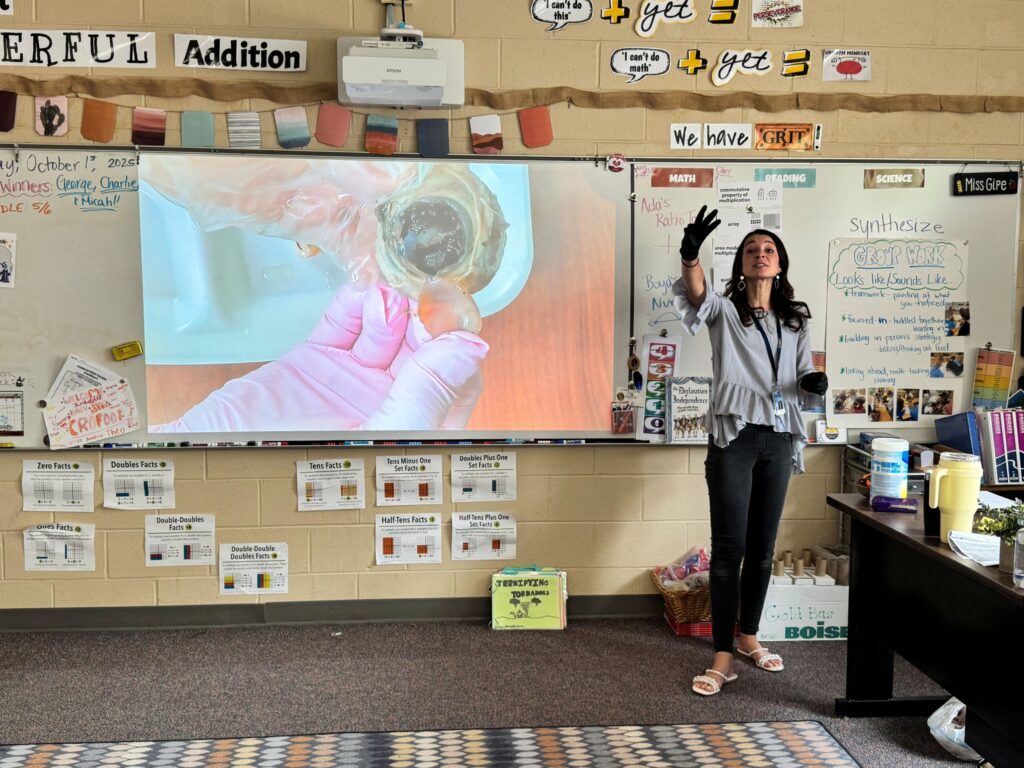
Teacher Katheryn Crofoot led the school’s fourth-graders through a dissection of cow eyes as part of their life science curriculum.
Students had mixed reactions as they filed into Crofoot’s room, warily eyeing the pile of bulbous lumps in the corner, which seemed to be staring everywhere and nowhere at once.
“Eww!” one shouted immediately upon entering the classroom.
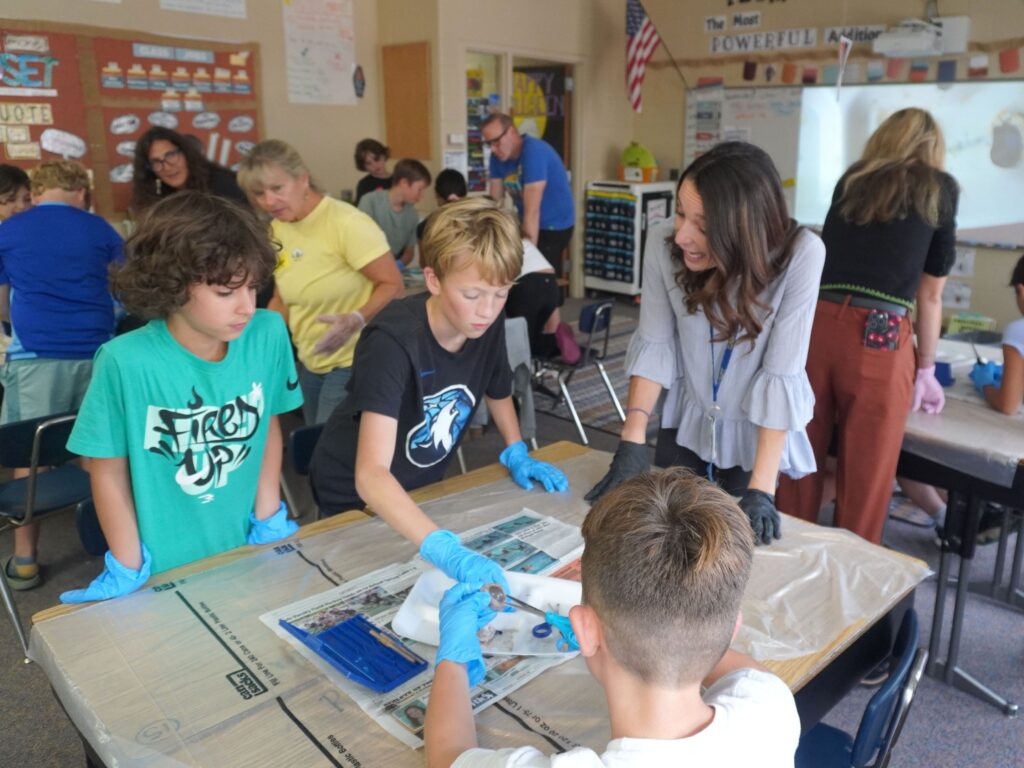
“Cool!” countered another.
Some held their shirts over their noses to escape the odor. Others were eager from the outset to start slicing.
But, aside from a few students who had to step away, just about everyone adapted to the assignment once the work got started.
Exploring the Eye
Under the guidance of Crofoot and several parent-volunteers, the fourth-graders broke into groups of four or five to bisect the cow eyes. They used scissors to cut the eyes in half before examining the contents.
George Hoksbergen noted the unexpected tough, wet texture of the eye while wielding his scissors. “I thought it was going to be soft and easy.”
Once his group’s eyeball was sufficiently halved, George remarked, “There’s a lot more stuff inside than I thought.”
That “stuff inside” included the tapetum, a reflective layering that allows cows and other animals to see well in the dark. Seeing the multicolored tissue was a highlight for Roscoe Newman, who spotted and identified it at once, quickly becoming his group’s expert on the matter.
“I just like the sheen,” Roscoe said.
‘It makes me so impressed with the kids and their resilience. Because a lot of the time even I find it kind of gross.’
— fourth-grade science teacher Katheryn Crofoot
Asked if he wanted to be the one to remove the tapetum from the eye, Roscoe replied, “We can all do it. I’m just a guy who likes tapetums.”
His affection for the tapetum comes from knowing that the retroreflective tissue, found behind the retina, helps keep his family dog safe when it’s outside at nighttime.
The tapetum was a new concept for Charles Stoffer, who said it was one of the more interesting things he learned during the dissection.
“I learned that there was a rainbow thing in the eye and I cut it open.” Charles said. “It was blue and black. It was colorful. It probably lights up and makes them see in the dark.”
Noted group mate Maxwell Anderson,“The first time I felt it, it felt weird, but then I got used to it.”
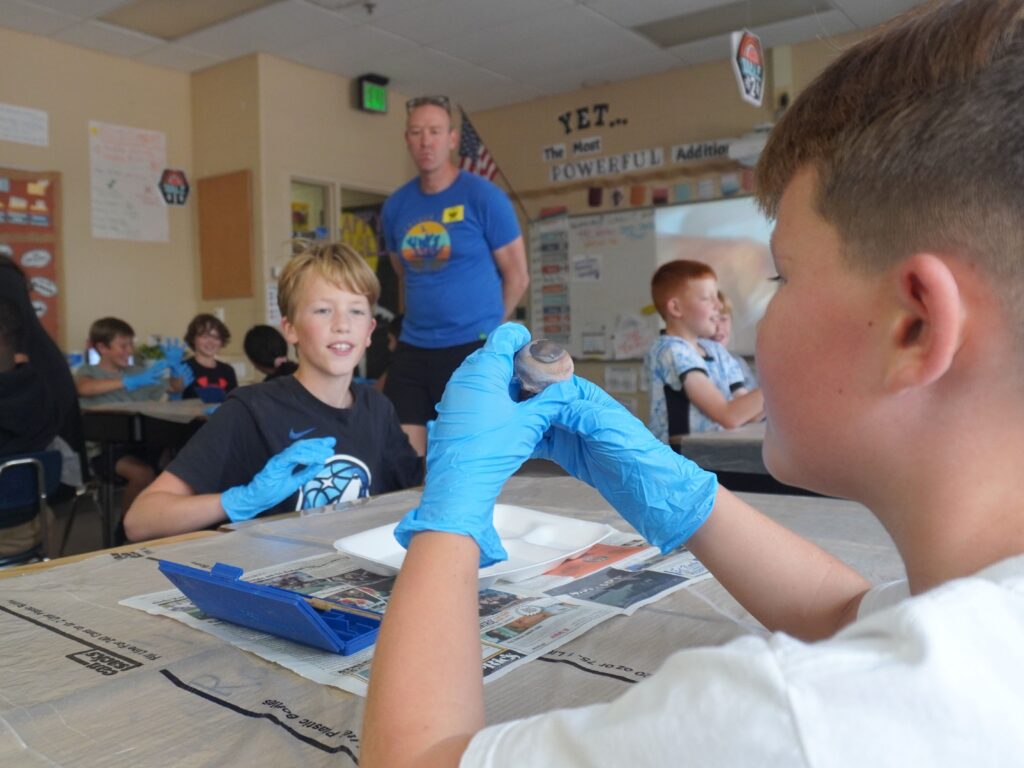
That wasn’t the case for Sammy Sisson, who made it through almost the whole dissection before excusing herself near the end.
“It was disgusting. I stepped away on the last step,” Sammy said. “It was cool but disgusting at the same time.”
‘Breaking down how things work’
Crofoot said dissection plays a critical role in the fourth-grade science curriculum.
“One of the aspects of fourth grade is breaking down how things work,” she said. “We study the structure of the eye as an aspect of how we interpret our senses. We’ve already learned about how we see, how we need light for sight, and now (students) get a chance to see the inner workings of the eye.”
Dissecting and examining the eye helps students understand, in a tangible way, what they’re studying and learning about.
“It kind of gives them that real-world connection to what it actually means to know how something works,” Crofoot said. “And even though it’s a cow eye, not a human eye, there are so many similarities that we can connect that to.”
The science teacher added that she’s amazed how well her students handled the assignment.
“It makes me so impressed with the kids and their resilience. Because a lot of the time even I find it kind of gross,” she said, adding that even the students who had to take a step back from the dissection still learned something.
“Quite a few kids have that trepidation, but generally, almost all of them at least at one point look at what it is,” Crofoot said. “We obviously always recognize comfortability, but sometimes I think it’s really great for the kids to recognize their own ability to work through something that they might at first find uncomfortable or be tricky to work through.
“Generally, I think that feeling of doing something they’ve never done before is a really cool feeling, on top of the fact that there’s kind of a ‘wow’ factor to it as well.”
Read more from East Grand Rapids
• Students soar into final summer STEAM lesson
• Painful condition can’t dampen grad’s ‘high hopes’ for the future


