


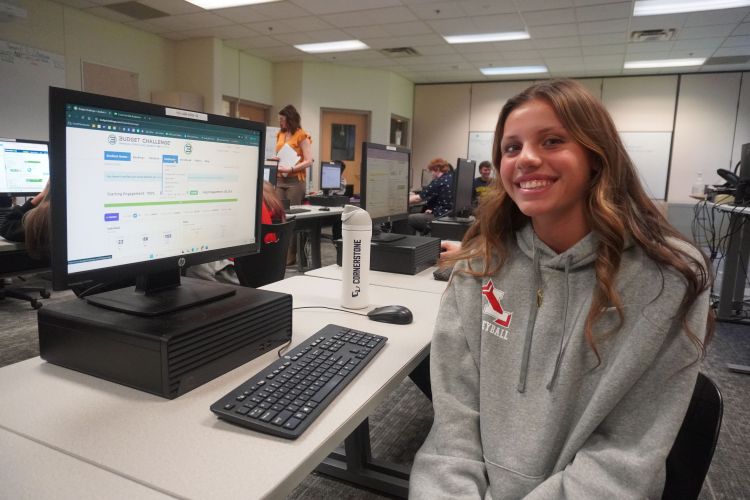
Lowell — Senior Delaney Lowe considered increasing her 401(k) contribution to 14%.
She had been contributing 12% of her salary to the investment fund, but reduced it to 3% when her finances got tight. Now, realizing she wasn’t on track with her retirement goals, she saw the fund needed a significant boost.
“I was going into debt, but now I think I am making enough,” she said. “I just don’t think 3% is good enough for me. I’m trying to figure out a balance.”
Students in Lowell High School’s personal finance class crunched similar numbers as they worked on the online simulation, Budget Challenge.
They were competing against each other, students in three other class periods, and a total of 261 students nationwide in the 12-week challenge to be the best budgeter. Teacher Kristine Stedman’s third-hour was proving to be especially financially savvy, ranking in 2nd place nationally as of mid-October.
‘This forces them to apply it and learn. They’ve made tons of mistakes, but they realize the cost of those mistakes.’
— teacher Kristine Stedman
Financial Tools for Future Success
Personal finance is a new requirement for Michigan students. A half-credit in the course, offered as a trimester class at Lowell High School, is required for Michigan students to graduate, beginning with today’s juniors, the class of 2028. Students can meet the requirement either through a stand-alone class or or in a course where standards are embedded, such as a career and technical education program, economics or math class.
Stedman is using Budget Challenge to expose students to real-life financial decisions. They work to tally points and earn trophies for maintaining strong 401(k) contributions, making on-time bill payments and having minimal debt.
For example, “We’ve been talking about credit scores,” she said. “They have a (simulated) credit card and (they learn) how to positively influence that credit card. Budget Challenge gives them five points every day if their credit limit is below 50%.”
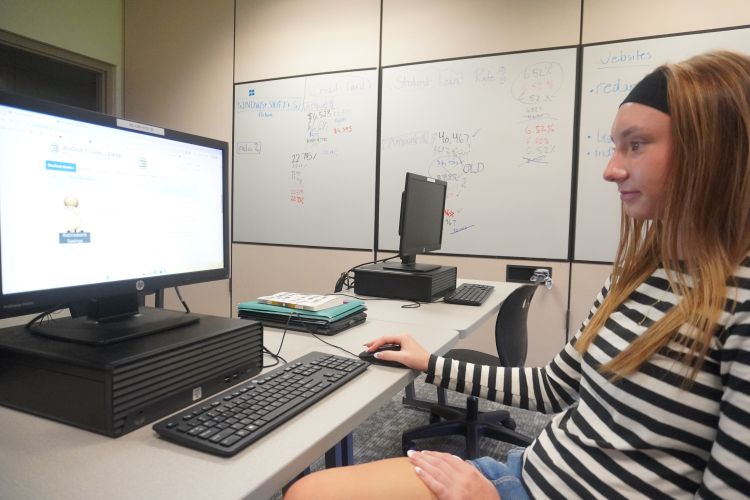
The class as a whole focuses on financial knowledge and independence, Stedman said. Topics include career pathways, college plans, benefits including investments and insurance, housing, and credit, debt and interest rates.
The challenge helps them see the reality of those things in adulthood.
“It’s the application of actually doing the stuff — paying back loans and trying to reduce their debt and trying to put money into an emergency fund and retirement — that’s what Budget Challenge does,” Stedman said.
Students pick options: do you want meter-based gas and electric, which results in varying bills, or a budgeted bill? Do you want to rent with one person or two? Do you want a higher deductible or lower deductible insurance plan?
Students track their costs and accounts on a spreadsheet, practicing budgeting a month into the future. That proves valuable over time, when they need to run their own households and budgets.
“This forces them to apply it and learn. They’ve made tons of mistakes, but they realize the cost of those mistakes,” Stedman said.
Seeking a Balance
In the simulation, Delaney was paying $600 a month for rent and stretching her biweekly take-home pay of about $1,200 to pay for utilities, a car payment, cell phone bill and all other expenses. An unexpected expense came up, and she had to pay $91 to fix a flat tire.
She said Budget Challenge had her considering, “Am I using my money well? Am I not buying random things? Am I not spending money that maybe I won’t have if I pop my tire and I need that $100?”
She said it’s a good time to be asking those questions.
“I didn’t know what half of this stuff was and it gives me a real-life example of what it looks like to pay my bills,” said Delaney, who plans to attend Cornerstone University next fall and pursue a nursing degree.
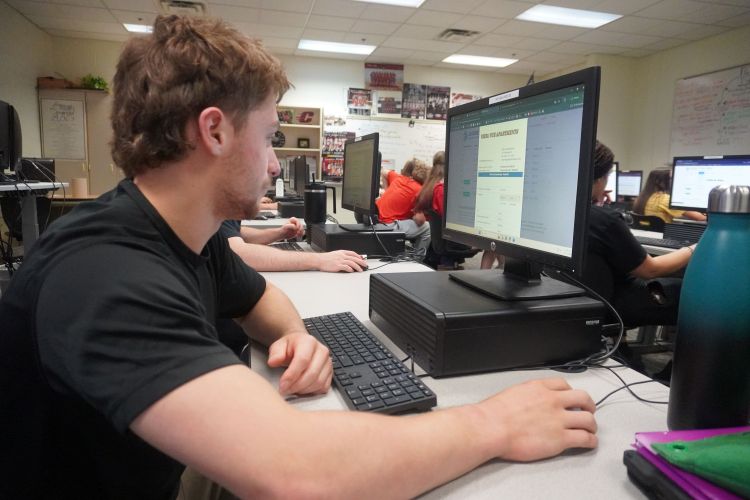
“I just committed to a college and I’ll be close to home, but I will have to get a job, and eventually I will move out and get an apartment. It’s good to know these are the things I will have to pay and this is how much it may be.”
Senior Tate Outman set his 401(k) contribution high, at 24%, to maximize his savings of $493.92 per paycheck. He opted for an apartment with a $1,110 rent. While he said he has money left at the end of the month, he’s made a couple mistakes.
“I’ve had a couple late fees for not paying on time,” he said, noting that he had first sent his contribution at 36%, but it was hard to make ends meet.
Senior Kara Havey set her 401(k) contribution at 20%. She pays $700 for a studio apartment and $369 for a car payment in the simulation.
“I’ve had to budget for my savings account, so I’ve added more to it each time,” Kara said. “I’ve got to keep up with my bills. I always keep enough in my savings account for unexpected expenses and make sure to pay off my credit card.”
She had to pay $268.15 for a new tire and her checking account balance dipped to $68.46, which she had to live on for two days before she was paid again.
“I learned how to manage my money pretty well because I had no idea how to do that before this,” she said. “I will definitely have a plan or a spreadsheet like this or something like this to help me manage all my bills.”
Read more from Lowell:
• Trio of area schools recognized for literacy achievements
• CAD Olympics put engineering skills to the test


