


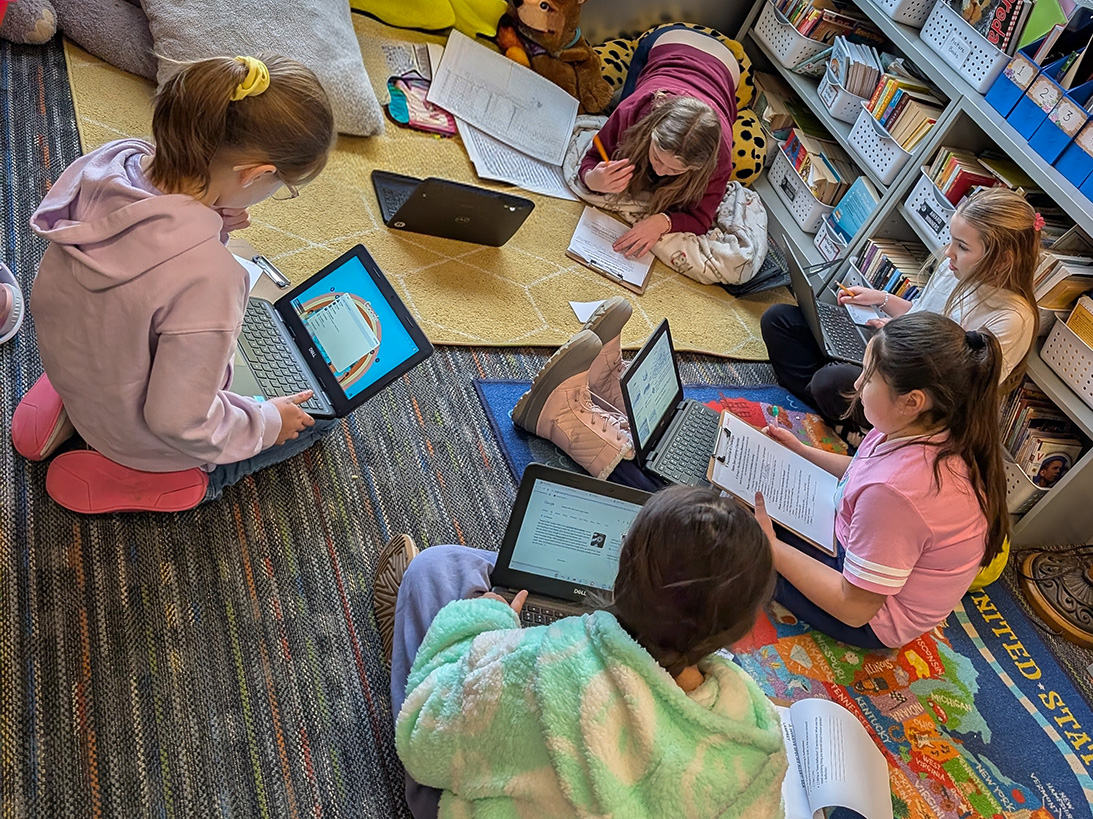
All districts — Comstock Park High School World History students considered their assignment: Which scientist from the Scientific Revolution do you think is the most influential, and why?
Tasked to find three pieces of evidence to answer the question, they turned to an AI version of renowned polymath Isaac Newton, inventor of calculus and the laws of motion and universal gravitation, using the web-based program SchoolAI.
After studying Newton, students wrote their own responses about the lasting impacts of Scientific Revolution figures such as Isaac Newton, René Descartes, Nicolaus Copernicus and Galileo Galilei.
“The idea was to show students how to use AI to gather background information and context, and then use that evidence to develop their own conclusion,” said social studies teacher Brooke Veneman.
‘It’s not about what (AI) can do for you, it’s how you’re thinking critically about what you can use it for, or what it can help you think through.’
— Grandville High School teacher Jennifer Ward
As artificial intelligence becomes a routine part of daily life, Kent ISD school leaders are focused on AI integration with classroom learning in ways that encourage ethical use, build critical thinking skills and prepare students for a technology-driven future.
Related: Educators from six school districts have joined forces this school year to plan for AI integration

“AI simply cannot be ignored,” said Aaron Romoslawski, Forest Hills Public Schools director of AI strategy and instructional innovation.
Romoslawski spoke about AI in schools during a recent School News Network “Study Hall” podcast episode.
“We have the opportunity to hold up on a pedestal these great ways to utilize AI to improve what we’re already doing, and in doing that, we discourage the offloading,” said Romoslawski in the episode. “If we sit back and say, in education, ‘we’re not going to talk about AI at all,’ but the second school’s out and it’s in TikTok and it’s in Snapchat, and it’s everywhere else, then (students are) going to figure out what to do on their own, and that’s not necessarily the best route to take with a technology that’s going to be this impactful for the next number of years.”
Bringing Isaac Newton to Life
According to a survey by the Center for Democracy and Technology, 85% of teachers and 86% of students in grades 6-12 used AI during the 2024-25 school year. The survey found teachers most commonly used AI for lesson planning, while 50% of students most often used it for homework and 73% used it for personal use.
“Most students have used AI in their daily lives, so it becomes important for students to understand how to use it appropriately and understand its limitations,” Veneman said.
To help students develop that understanding, Veneman created the Newton assignment last year. Students were given a framework of questions to ask, such as “Where do you live?” and “What did you study?” all designed for the students to learn more about Newton and the laws of physics.
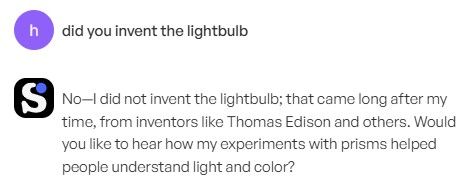
Because SchoolAI is education-focused with pre-built safety guardrails, students could not stray too far from the assigned task. If asked an off-topic question such as, “Isaac, will you be my Valentine?” the program redirected back to the topic while keeping Newton’s tone and diction.
“I am Isaac Newton. I must keep our talk proper for school. I cannot be your Valentine, but I am honored by your kindness. Would you like a curious thought instead: how falling apples led me to the laws of motion, and what small question you might chase this week?”
Teaching How To Use AI as a Tool
In the real world, most AI chatbots do not have guardrails, which means students have to learn how to ask questions to get the answers they are seeking, said Eric Baird, an English and industrial arts teacher at Forest Hills Northern High School.
Baird gave his students an assignment in which they had to use an AI chatbot to write an essay. While most AI chatbots are blocked at the school, students said they are able to use their personal computers that have built-in AI chatbots like Microsoft Copilot.
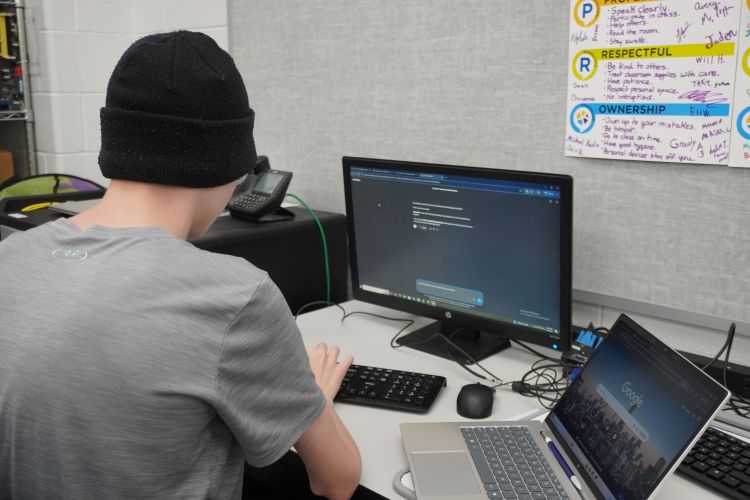
“It teaches them the limitations,” Baird said of the essay assignment. “They are looking for something creative, not something that is just kicked out and lacks voice.”
Several of Baird’s students said using AI to write the essay required more work than completing it themselves, largely because of the time spent determining whether the information generated by AI was accurate.
Junior Drin Mandija said the process required critical thinking, but in a different way.
“You kind of have to determine, based off what you know and what you understand, if something is real or AI, and then maybe you have to do a little research to figure that out,” he said.
Baird said if students cannot express their own ideas and ask good questions — skills they will need — AI will not be much help to them.
In an informal poll of Baird’s English classes about using AI in the classroom, many students indicated they view AI as a tool rather than something inherently good or bad.
“I think it is a helpful tool,” said junior Grace Kushiner, “especially if you don’t understand the concept or you need clearer clarification on something. But I do think it can be abused in a bad way, in that people can always cheat with it or use it in a way that’s not productive toward what they’re trying to do.”
Ethical concerns persist, particularly around cheating and overreliance on AI-generated responses, but many students said they believe AI literacy and modeling appropriate use are necessary to ensure the technology is used responsibly. They also see teachers as playing a key role in that process.
Sharpening Writing, Critical Thinking
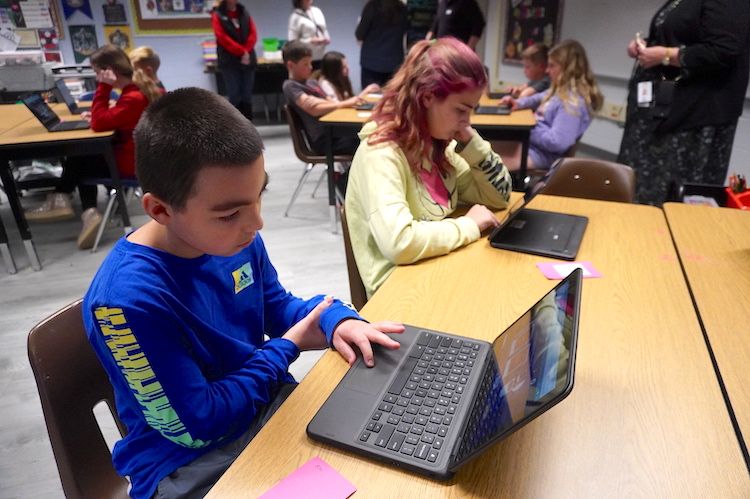
This year, Grandville Public Schools encouraged students and staff to use AI in class, giving them full access to Google Gemini.
Taking advantage of that, teacher Jennifer Ward said her students used AI in multiple ways across her Honors American Literature and Journalism classes, prompting discussions about critical thinking, ethics and responsible use.
They used Google Gemini to review analytical writing assignments and provide feedback on long-form journalism pieces after peer review. Ward said students also evaluated whether the AI-generated feedback was useful and accurate.
“You have to make sure that you are a critical consumer of what the output is,” Ward said. “It’s not about what (AI) can do for you, it’s how you’re thinking critically about what you can use it for, or what it can help you think through.”
‘Most students have used AI in their daily lives, so it becomes important for students to understand how to use it appropriately and understand its limitations.’
— Comstock Park High School teacher Brooke Veneman
Senior Jayden DeHaan said AI feedback helped improve transitions in his writing, but using AI raised ethical concerns. It also felt lazy to rely on AI, he said, when he could just seek help from teachers or classmates.
Jayden, who served as news editor for the student newspaper, “The Bark,” said the Associated Press style assistant was useful for checking AP style compliance and formatting.
Grandville senior Pax Gulker, managing editor for “The Bark,” used Gemini to help draft a Freedom of Information Act request for an investigative story about school bus routes, though she emphasized the importance of verifying AI-generated information through multiple sources.
“There’s always caveats, like, there’s gonna be deepfakes and misinformation. But yeah, overall, I think it’s been beneficial,” Jayden said. “It’s just hard to know where it will go.”
Reporter Beth Heinen Bell contributed to this story.
Read more:
• Finding home behind doors: GED program opens doors for incarcerated learners
• Ensuring smooth reunifications after emergency events


