


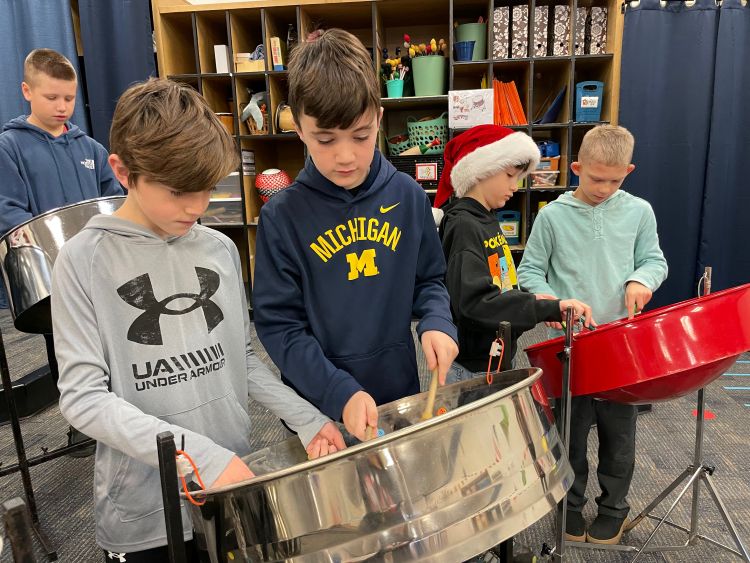
All districts — Sparta, Michigan, is a long way from Trinidad and Tobago, but thanks to grants from a state-funded council, Appleview Elementary has been able for years to bring steel drum musicians from the Caribbean country to rural Michigan.
The visits not only teach students about the instruments, said music teacher Adria Van Wyk, but also about Caribbean culture.
“(They) look forward to this experience every year,” she said. “Considering that a number of our students have never been outside of Michigan, or even Sparta, this program brings world culture and sounds to us.”
But that program and hundreds of others throughout the state are threatened with elimination when the state finalizes its 2027 budget.
The Michigan State House of Representatives has voted to approve a state budget that would eliminate the Michigan Arts and Culture Council; cuts could come as soon as the end of this fiscal year.
‘We cannot afford to treat our cultural infrastructure as disposable.’
— MACC Executive Director Alison Watson
The state-funded council distributes more than $11 million in grants annually to nonprofit arts organizations. This 1% of the state budget impacts more than 11.1 million individuals and creates $434,774,716 in direct expenditures.
“To hear that (Sparta’s steel drum) program is even being considered for cuts — and worse yet, elimination — is devastating,” Van Wyk said. “To cut programs like this does not serve our students and would be a detriment to their learning — and as a result, eventually to society as a whole.”
‘A fundamental pillar’
The council was originally established as the State Council for the Arts, and was officially founded in 1966. It has funded programs at public and non-public schools throughout the state, as well as libraries, museums and arts organizations including the Grand Rapids Public Library, the Grand Rapids Public Museum and Artists Creating Together Inc.
“The arts are not a luxury or a line-item afterthought; they are a fundamental pillar of community health, economic resilience and identity,” said MACC Executive Director Alison Watson. “To eliminate public arts funding is to shortchange our children’s education, dismantle living-wage creative jobs and silence the cultural storytelling that makes Michigan a place where people want to live, work and build a future. We cannot afford to treat our cultural infrastructure as disposable.”
For example, MACC’s Arts Equipment and Bussing Grants provide up to $1,500 for equipment and repairs, and $500 for cultural field trip transportation.
And research has long tied arts participation to better student learning. A 2025 report of the National Endowment for the Arts reaffirmed previous data that links access to arts education with positive overall academic and social outcomes in children.
‘To cut programs like this does not serve our students and would be a detriment to their learning — and as a result, eventually to society as a whole.’
— Adria VanWyk, Sparta Area Schools music teacher
Lowell Area Historical Museum Director Lisa Plank said her organization utilizes MACC funding toward a number of education programs every year for Lowell elementary schools.
First-graders get an introductory tour of the museum; for second-graders, it’s a pioneer maple syrup program at the local nature center and a “Past vs. Present” museum tour. Museum staff and volunteers also visit every LAS second-grade classroom for a presentation on immigration to the area and early settler life.
In third grade, the museum partners with Heidi’s Farmstand to present fall programs; students learn about the native American Odawa, how the fur trade worked in that period and about pioneer farming. All area third-graders also attend the museum’s immersion program, a hands-on, in-depth look at various aspects of local history and how museums work.
“These grants ensure that even when local school budgets face constraints, students still experience the tactile and cognitive benefits of a creative education,” Watson said. “Without this public funding, many of these school field trips and specialized arts programs simply would not exist.”
Arts Investment Pays Dividends
If MACC is eliminated, Michigan would be the only state in the country without a state-funded arts agency, impacting both some 144,000 people who currently work in its creative economy and the state’s ability to attract and retain that talent.
A list of MACC programs conducted around the state in 2023, the most recent data provided, is available online.
The U.S. Bureau of Economic Analysis reports that arts and cultural production accounts for an estimated 3% of the Michigan economy — some $18 billion — and supports more than 120,000 jobs.

Public investment acts as seed money, Watson explained; for every dollar the state invests, it leverages more in private matching donations, ticket sales, dining and hospitality revenue.
“Eliminating this funding effectively starves that economic engine,” she said.
For Lowell’s Plank, the negative impacts are exponential when considering the programs the museum offers build on one another, adding knowledge and experiences for the students.
“We often hear from (students) that they can’t wait for the programs they have heard are coming the next school year for them,” Plank said.
Plank called MACC funding “the bedrock of these programs. If that funding disappeared,” she said, “it would be difficult for us to fund them. We would need to find other funding sources.”
Read more from our districts:
• For curious third-graders, museum is the perfect classroom
• ‘They learn by music’


