


Multiple districts — Like so many across America, Troy Ungrey remembers exactly where he was on the morning of September 11, 2001: teaching United States history to sophomores in room 265 at Grandville High School.
“It started out like every other day,” he said — a familiar refrain for those who witnessed, live or on screen, the terrorist attacks in New York City and Washington, D.C. that day. “I’ve got my lesson plans ready to go; I was fired up to get started.”
That’s when a colleague from across the hall popped in to tell Ungrey to turn on the classroom TV. He said it was important, Ungrey recalls, so they switched on the 17-inch screen mounted from the ceiling in the corner of the room. Without the distraction — or resource — of smartphones, he and his students confusedly watched smoke rising from the NYC skyline for about 10 minutes, he said, until together they witnessed a jetliner strike the second World Trade Center tower live on network television.
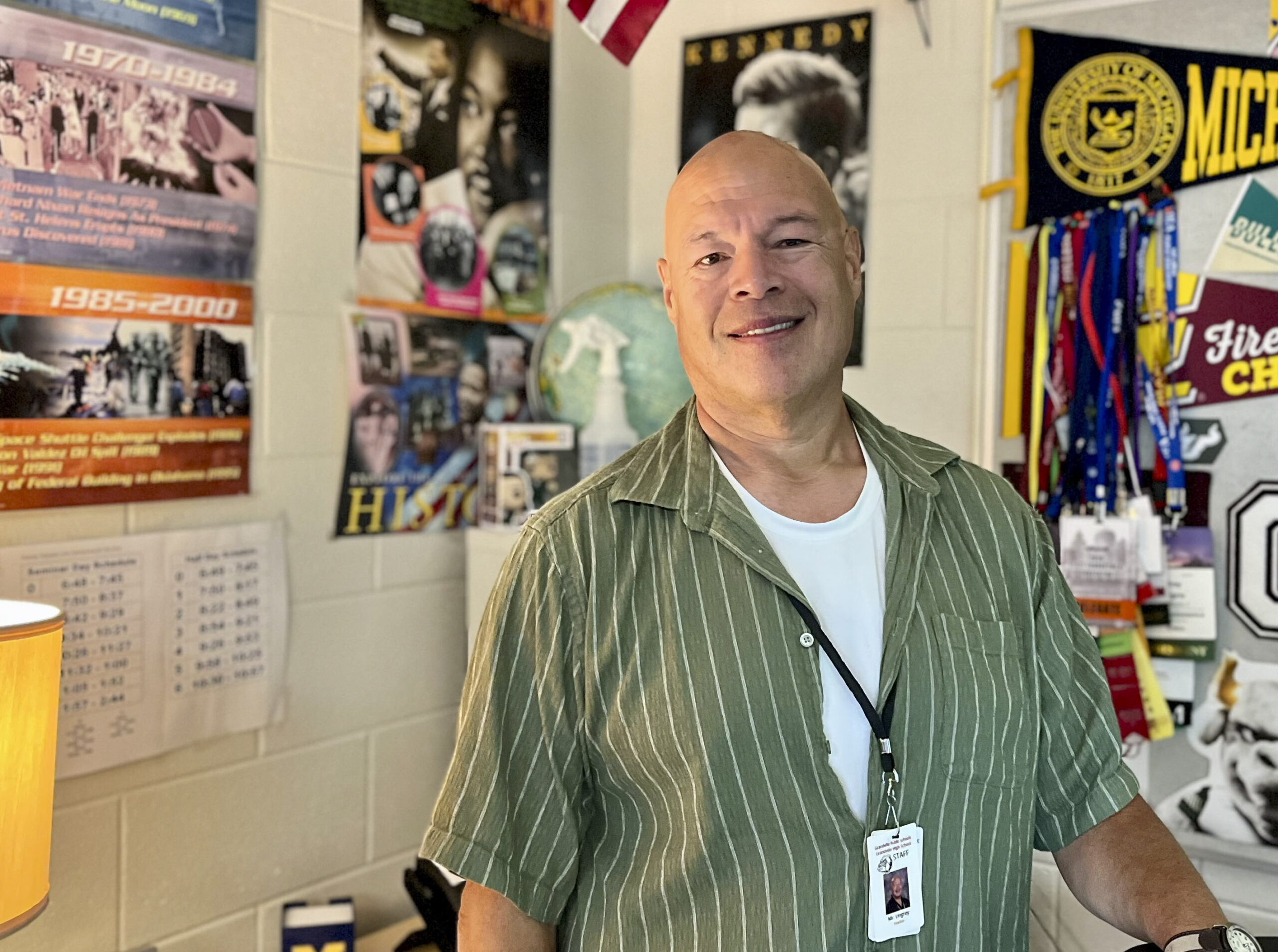
The memory still gives him chills, Ungrey said, pointing to the raised hairs on his arm.
“Immediately, the lesson plans were thrown out the window,” he said. “The mood of the entire building went from, ‘Another day of education,’ to, ‘What’s going on?’ Just being stunned, not understanding, wanting more information. … And then, essentially, the world itself just shut down.”
As the nation marks the 25th anniversary of those attacks, teachers are tasked with teaching modern American history to a generation of students born post-9/11. For some, like Ungrey, the memories are personal, though the lesson plans have changed. Other teachers newer to the profession are already nearly a generation removed from the attacks.
‘Understand what’s going on globally’
That includes Kentwood’s Anthony Tran, who was just a toddler in 2001. When Tran teaches his East Kentwood High School civics and world history students about 9/11, two questions inevitably pop up.
“The biggest question is ‘Mr. Tran, you were only 2 years old? How do you remember anything?’” said Tran, who is in his fifth year teaching. “I’m like, ‘I don’t remember.’ The second biggest question I get is, ‘What did (the U.S.) do afterward?’”
Tran plans to teach about 9/11 through a comprehensive lesson on what led to the attacks and the fallout that resulted. He is using primary sources including screen captures, news articles, videos and audio to show the minute-by-minute play-by-play of what happened when the towers were hit and fell.
East Kentwood is the most diverse high school in Michigan, but even newcomers from different countries are familiar with 9/11, he said. Still, he expects students to have a visceral reaction to the footage.
Then, Tran plans to go into depth, having the class analyze the history around the event from a present-day perspective, he said.

“I have to bring in what happened 20 years (before 9/11) and I have to bring in what happened 20 years later. How has the American attitude changed toward the Middle East and what did we do prior, during and after?” he said. “Let’s understand what’s going on globally.”
The world changed forever because of the attacks, which can lead to lots of discussion, he explained.
“It’s a flashpoint for everything that happens afterward. (The class examines) how do we change our domestic policy and foreign policy from this point? How do we interact with different regimes around the world? … How did the TSA change?”
Tran remembers learning about 9/11 as an elementary student during moments of remembrance and by watching footage. As a college student, he delved into the context surrounding the attacks through his focus on social studies, specifically on Asia, spanning from the Middle East to Micronesia.
Those studies, along with his perspective as a child of refugees who fled Vietnam by boat in the 1970s during the Vietnam War, have shaped his knowledge about 9/11. Tran’s father was 17 years old and faced the choice of fleeing or becoming a prisoner of war in Vietnam.
“When my parents saw what happened after 9/11, (they said) ‘We went through this great journey; we came to the land of opportunity … this is an awful thing that happened,’” he said. “I remember them telling me as a little kid, ‘This is the worst terror attack. America is the land of freedom, why would you ever attack it?’
“They saw the same thing in their own country. This is what happens when another power steps in and destabilizes everything.”
Tran now challenges his students to consider events that happen across the world and how they impact others’ lives.
“The biggest thing I want them to have is empathy. One of the biggest tools we have in history is understanding multiple perspectives and understanding why things happen,” he said.
‘Kids understand bravery’
Kent City Middle School English teacher Nicole Lindeboom, who was eight years into her teaching career on the day of the attacks, also embraces the empathetic route.

“When it comes to 9/11 and its impact, my approach is, it’s about being kind to people, bringing out the heroes and not profiling any one group,” she said.
Lindeboom, who as a high school student had lived through the space shuttle Challenger explosion, intentionally did not turn on her classroom TV that day to shield students from the news. Still, in the days that followed, she fielded some big questions as kids processed the events.
“With middle-schoolers, their world is very small, and New York was so far away; when we were canceling sporting events, they really didn’t understand why. They were just kids; the situation hadn’t set in,” she said. “But later there was nervousness about being at big sporting events or big crowd gatherings.
“In our daily sharing time, we’d talk through it. I told them I had fears, too, and that it’s okay to be scared. That we’d work through it together.”
When teaching 9/11 to middle-schoolers now, Lindeboom shows them videos and photos, some taken during her visit to the 9/11 Memorial Museum in New York. In her classroom library she includes books related to the attacks that students can check out all year long. And she looks for literary themes in books they study to thoughtfully bring up discussions around racial profiling.
“While it wasn’t our best moment as a country, I can use 9/11 in that discussion because of some of the profiling that took place after (the attacks),” she said. “We talk about not blaming a group for certain individuals’ actions, and that’s a lesson I think we can all take to heart.”
‘History is the idea of looking in the past and seeing the steps we’ve taken to make things better in the future.’
— Grandville history teacher Troy Ungrey
She also takes inspiration from Kent City itself. In the days and weeks following the attacks, Lindeboom said she was proud to see the community’s tremendous humanitarian response, including blood drives, fundraisers and volunteer opportunities. When talking about 9/11 today, she’s used those examples to encourage students to look for — and be — the helpers.
“Kids understand bravery,” she said. “They understand first responders and the regular everyday heroes. That’s something they can connect with, even if it happened years ago.
“I don’t want to downplay how awful it was. But the resiliency, the community of people stepping forward and making sacrifices, knowing that we can come out of a horrible event, be united and help each other, that’s what I hope (students take away).”
Using History to Find Solutions
In Grandville, Ungrey still teaches high school U.S. History in classroom 265. The TV they watched back in 2001 is no longer mounted to the ceiling, but the outlet where it was plugged in remains.
What has changed more significantly is the content of his modern history unit, in which 9/11 has become a key touchpoint impacting several national and global issues. The unit starts around 1993, with the first attack on the World Trade Center that year serving as an on-ramp to everything that has happened afterward.
“I talk about domestic terrorism and essentially any type of terrorism that has dealt with the United States, domestic or foreign,” he said, including the 1996 Olympics attack, the Oklahoma City bombing, the embassy attacks in Kenya and Tanzania and the rising impact of al-Qaida.

“(Students) learn that (terrorism) wasn’t necessarily a new thing in 2001, but we talk about the naiveté of the United States government and people in general feeling like, ‘it can’t happen here.’”
In discussing 9/11’s impact, Ungrey’s classes touch on topics like the creation of the Department of Homeland Security, government tracking of money coming from suspected terrorist organizations, the hunt for Osama bin Laden and the United States’ increased partnership with other countries against both foreign and homegrown threats.
“History is the idea of looking in the past and seeing the steps we’ve taken to make things better in the future. It’s finding solutions,” Ungrey said. “(9/11) has that recurring theme that weaves its way through everything we do in terms of the safety of Americans. … I hope (students) walk away with the idea that the safety they have today was a learning experience for a lot of other Americans — that they can appreciate those steps that were taken to make sure we’re safer than probably ever.”
Like other educators, Ungrey teaches about the day of the attacks using movies, videos and other primary sources, including his own story of being in the classroom 25 years ago, the way details unfolded slowly in the hours that followed, and the feeling of having more questions than answers.
In doing so, he hopes to both make history personal for students and remind them that there are no dumb questions.
“I think those years have instilled in me this idea of making sure that I make those connections. I have the connection (to 9/11) and they don’t,” he said. “If I don’t do that, it’s just names and dates. I want to go deep and get them engaged and have them ask questions and get them to critically think about what happened and why. And when they ask me those questions, I know I’m doing my job.”
Reporter Erin Albanese contributed to this story.
Read more from our districts:
• District leaders: State changes to school funding will help meet needs for all students
• From SchoolAI to Google Gemini, students learn to navigate AI


